voodooEntity
Joined 7 years ago
Karma
394
Submissions
164
Member since
Oct 7
Joined 7 years ago
I think its important that people don't just look at whats implemented rn, but rather just try out new things , not just "adjust" the existing ones. Thats how we got better progress, not by trying to build the 1000s variant of context compression but rather reconsider how can context be build to not have this issue (simple example).
Don't really understand why other agents to give those insights but well found my solution.
One side is that i started developing it with godot, and the game has well alot of menu stuff going on (without wanting to go to much into detail but you are to a certain degree able to configure units outside of a match into "blueprint" like system). This whole editor / management etc stuff got quite big and works really well.
Means, when i hit the gdscript limits, i did not want to port all of the existing stuff that already works perfectly fine with godot.
And ye since the c++ only runs math simulations but i still use the godot renderer (which so far seems to work out perfectly fine) i was okay with that mixed solution (for now).
The other reason is that in my well closer circle i got quite some people that code c++ on a daily basis and i don't know (at least i think so) anyone doin C# actively, so i thought if i would get stuck i have people i can easily ask about my c++ problems.
So it wasn't a "i think c++ is better than c#" decision rather a what do i know and what resources i have available easily.
Than started to move alot of heavy logic to c++ simulation : tedious indeed but the results speak for themself.
Basically allows me to use godot for things like menus dialogues and similar stuff while running the true heavy work in a c++ simulation.
While you might think "yey another coding agent" i went down some very different paths than other open source coding agents do right now. Ill not bore you with a ton of detailed breakdowns and rather list the main points that are relevant to understand why/how i build it.
Premise:
-The agent is meant to run against selfhosted environments first like Ollama etc with a focus on non cloud sized models, it should work properly on something like a 27b model already
-The agent with full intention trades execution time vs reasoning and result quality
So what does it do different:
1. The agent, instead of trying to let the model solve a whole task in 3-5 inferences, rather breaks down the "thinking process" in smaller chunks, basically decomposing the task into smaller tasks. While this is not a completely new concept, the agent will break it down to really simple single step variants which even for a smaller model can properly be solved. This involves not just file editings but all points along the way from interpreting user message to planing a task to defining acceptance criteria etc.
2. The agent is build in a way that it, apart from some fixed steps such as detect user intent at the beginning and synthesize response at the end, it will by itself decide what is the next proper step to execute/do based on the context i provide. While doing so the agent also revalidates its current execution and if it spots that, given the information i collected since it planned and started running, the current plan is not detailed enough or is missing out due to something he didnt "know" when he was planing, the agent will dynamicly mutate the coming plan stats, as in restructure/decompose/etc in order to have a properly layed out route to fulfill the task.
3. The agent has a rather complex system of how his context is composed which is combined by things like the chat history, previous step results, a backlog of what "single steps" it has done (updated file x , read range from file y etc) and in that it is strongly reason driven, so it will for most of the things it does also provide a small reason explaination for why it did that. Than the agent also has a working memory that contains facts and decisions it made along execution. There is more but thats just some thingsd to mention. The whole memory system and context is rather complex (tho not complicated). When i release it ill properly break down how all this works in the docs.
4. The agent provides full observability in the ui. At every point of execution you can basically in detail see whats in memory, whats the current composed context, whats the plan and what plan steps depend on what previous steps, you can look at artefacts it build and also you have basically a complete audit log of all single "actions" it has executed and can look into their details.
5. The agent allows to while in an execution send steering messages, meaning the message will be, using relevant current contextual information about its execution, send as inference with a prompt askind the agent to interpret on if its relevant, and how does it impact the current execution/plan. It than can decide either just do alter what it currently does, or even do a plan mutation in order to accomodate the users steering information.
6. The agent within its capabilities has a lot of error correction/self reflection logic. From dynamicly fixing json including a fallback to let LLM fix a response json, upon to if executions fail to much it will itself do a hypothesis on why this is happening, formulate a critique and with that reevaluate if it wants to try the steps again with the additional information, or if it wants to mutate the plan to accomodate the just spotted problems.
Theres quite some more i could list but i guess thats enaugh for now. The big trade off as mentioned earlier is execution time. In comparsion to cloud native agents, which will do giant editings and reasonings in just a hand full of inferences, my agent uses a ton of inferences. The big difference is that this allows (a) the agent to more precisly focus on specific tasks rather than overloading it with to much at once and (b) alot better spot problems/mistakes itself and adjust its execution plan to accomodate those without the user having to reprompt the agent 10 times until something is actually correctly solved.
Apart from the pure coding capability, the very same actions that allow for higher quality reasoning and coding at the same time allow the agent also be a good analysis and discussion partner.
So : what is it than used for if inferences and executions can take very long? Well for me its in terms of coding capabilities a hands off agent. Its meant to be informed once at the beginning with relevant details, and than should be fully capable (as long its in the capabilities for sure) to fulfill the task without the user having to permanently keep an eye open. I want to free time for myself and not change my time from coding to prompting.
Ill wrap it up here and say : the Agents name is "Loa" and i probably will post it on hackernews as soon i got a relatively stable beta to release. Im close to being fine with a beta release but i want to test some more runs before i publish.
Cool idea tho to make it as accessible (:
Basically a 2d rts, fully orthogonal view, plays in space with spaceship combat.
You start with a deployable base, kinda like the old C&C, which you can place around a minable planet. Than from this you can place further structures arround that planet including the typicals, mining (2 types) of resources, researching stuff, and building ships.
The 2 things i focus the most on in this game on are
1. Responsiveness. Im a strong fan of starcraft 2 (and brood war) and have spend tons of time playing sc2. I love this super responsive controles and its the only thing i will settle for in terms of controles
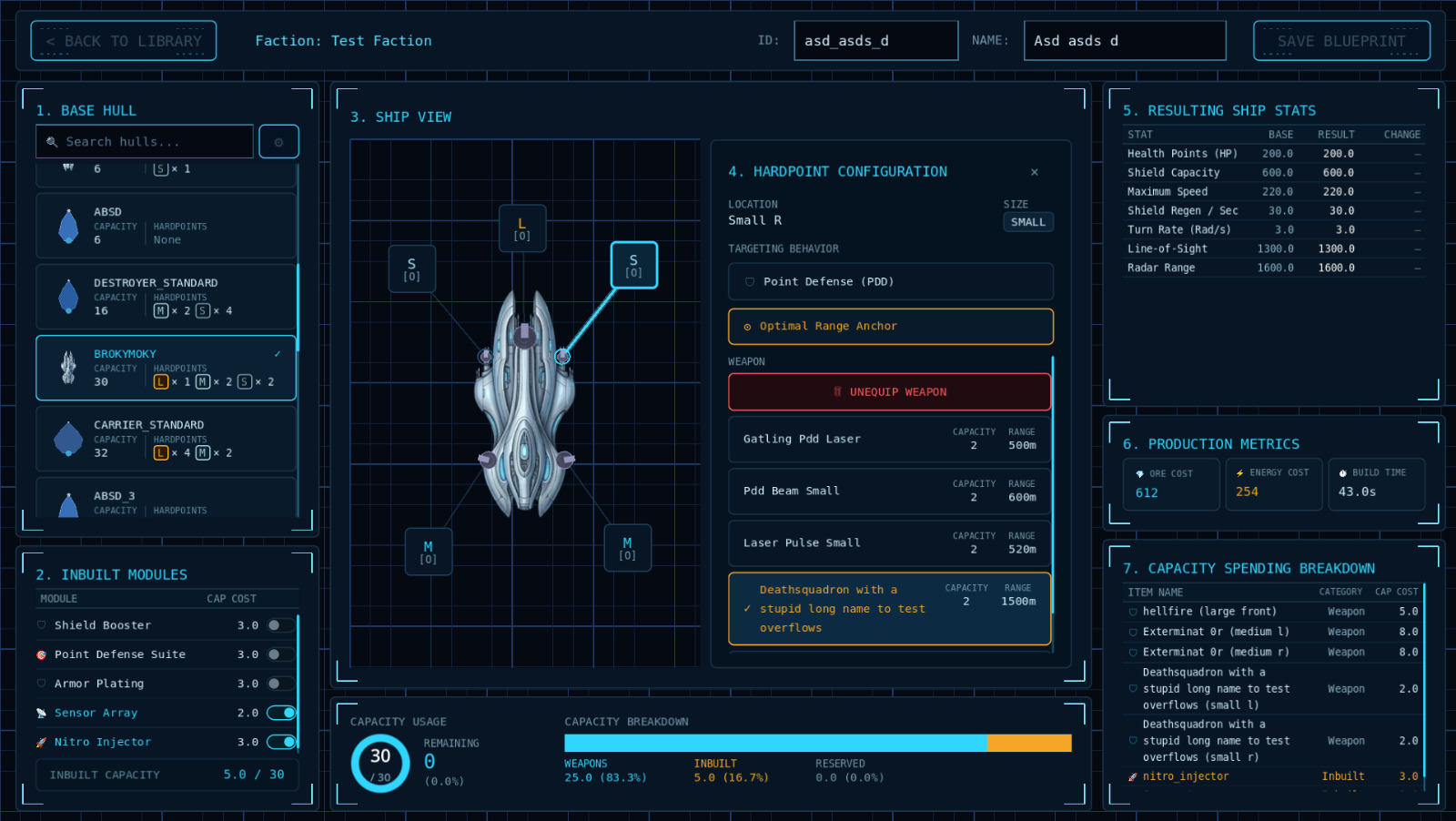
2. I love the game starsector (yes no rts) for the way its ships are designed. You have a base hull that has some stats like hp / speed / etc - than this thing has basically mountpoints where you can fit weapons into. I always loved this system. So what i build is a game where you can (outside of battle) define your desired ship blueprints combined of a hull, weapons and "inbuilds" (as in upgrades). You can than just build those ships ingame.
So ye made quite progress so far , not sure tho what will be the first mode i focus on once i get a playable (as in demo) state.
Btw using godot engine as base, but some logic is running as c++ gd extensions (rts is heavy calcs , gdscript is just not fast enaugh (or im just not a gamdev ¯\_(ツ)_/¯)
Here a screenshot of the ship blueprint editor for those who are curious - https://i.postimg.cc/bq5JB9J7/editorexample.jpg