tjpd
Joined 16 years ago
Karma
324
Submissions
44
Member since
Oct 12
Joined 16 years ago
Handyschwelle?
Or more formally: Mobiltelefonbremsschwelle?
Pinkie is a term used to describe young pro-China online posters.
https://en.m.wikipedia.org/wiki/Rare_earth_industry_in_China
Rather, when you add it all up: the loss of many of the things that made SF fun; increasingly distributed labour, capital & opportunities for start-ups/VC; SF's seemingly unsolvable problems (cost of living, homelessness, spotty public education, irregular transit, weather...) - just what is the bull case for SF anymore?
I honestly wish I had a good answer.
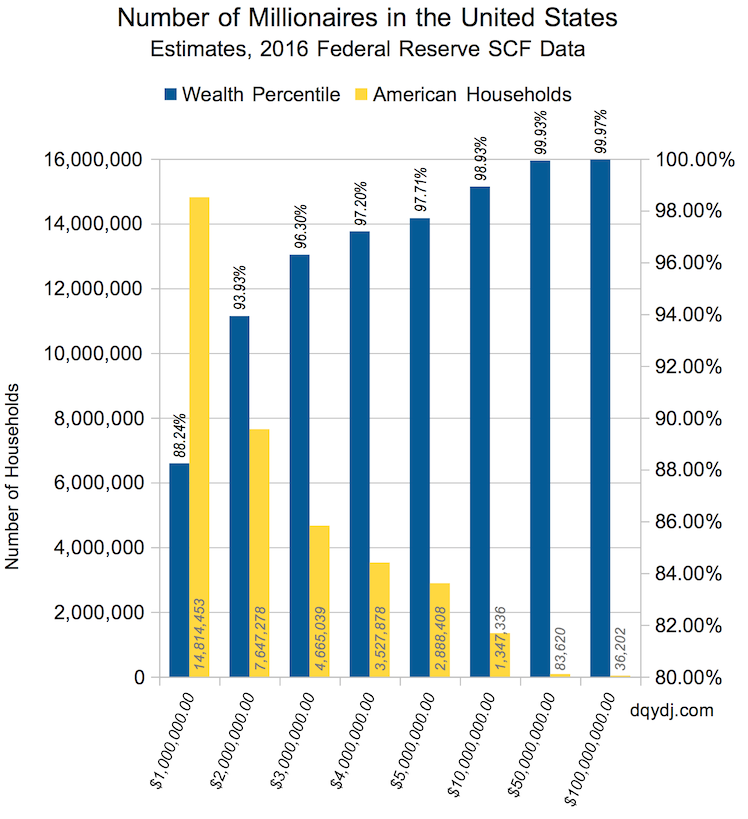
We can actually look at the Fed's Survey of Consumer Finances and get a reasonable number here. Household's with >$50m are top 0.07% percentile and there are approximately 84k of them out of around 130 million households....
[1] https://cdn.dqydj.com/wp-content/uploads/2017/09/millionaire...
In the Bay Area you're already subject to a form of wealth tax called property tax. And it's substantial. If you live in San Francisco you'll get charged 1.1801% every year [1] on the value of your wealth (property). If I bought a house in SF and live for another 60 years I would be taxed 60 times on that same asset. Does that mean the government will over the course of my life take 33.6% of my house?
It's not as if property tax has kept a damper on Bay Area house price inflation.
[1] https://sftreasurer.org/property/understanding-property-tax
Here's my outsider's guess: Dave was almost certainly a Key Person in 500's Limited Partnership Agreement. When a Key Person leaves, for whatever reason, that triggers a Suspension Event and the start of the Suspension Period. During the suspension period, the LPs are not required to contribute capital except for certain things (e.g. management fees, follow-ons). The LP's (some threshold or some combination of them like the LP advisory committee) then have 60-90 days to vote whether or not to continue with the fund.
500 would already have called down some capital so that meant they could make a few investments but otherwise, during the suspension period they likely couldn't make any new ones. Since then they got their LPs on board with the idea of continuing without Dave and now can fulfill all their obligations. That would make sense to me because 500 as an institution is much more than just one man.
> That sounds odd too me as well, maybe I am not versed in startup culture. Having a goal of going from 230 to 300 people seems like a pointless metric (and wasteful). It's like saying "I want to write 1000 lines of code today".
I understand this criticism but I think the intent behind their statement is different from the intent you're reading into it.
It sounds like you think they're using it as some kind of empire building management metric (I might be wrong). ie. 300 people and well be a great company! As you say that'd be pretty stupid and so I doubt that. Here's my guess: the headcount number is by product of a broader growth plan. ie. We need to get to X revenues, or scale to X users, or build Y products in Z months which means we need to hire X engineers, Y marketers, Z salespeople in a certain time frame.. add all that up and that means we need 300 people by the end of 2017.
The reason it gets boiled down to 300 is two-fold: 1) It's just hard to get a journalist to be interested in that kind of considered detail & much easier for journalists to remember that one number 2) It's actually still a good signal in an ultra-competitive hiring market. ("you bet we're hiring!, we have lot's of jobs openings! didn't you here we're looking for 100's of people, come and help build that site that you already spend half day on")
300 as a management metric = no sense; 300 as by product of growth plan, headline grabbing takeaway, beacon to potential talent = better.