sigil
Joined 16 years ago
Karma
3,695
Submissions
788
Member since
Apr 28
alangrow.com
View on Hacker NewsJoined 16 years ago
When I was a software library developer, I came to resent application developers. I noticed a pattern. Libraries solved hard problems and did so carefully, thoughtfully, in a way that others could reuse. Apps would come along and carelessly, recklessly glue together several high quality libraries into a piece of software targeting a general audience. The apps would then harvest all the credit.
What's happening in mathematics right now feels similar. Applications (theorems) were always how one built objective reputation, but libraries (concepts, definitions, boring lemmas) were also rewarded socially within the mathematics community. And individual mathematicians often managed to both build their own libraries, and use them to prove an important result. And then those libraries were sometimes of use in other results.
Bessis asks whether AI Lean proofs will land in Mathlib or Mathslop. Or in my framing: will they be libraries, or applications?
At present they're mostly Mathslop. The proven result is perhaps useful, but the methods employed aren't novel or reusable. I worry that this trend will only worsen, because applications make headlines, and the libraries they used do not. We are not properly incentivizing library development in OSS, or in math, or in infrastructure writ large. There's a serious credit assignment problem here.
What might change this? Once the low hanging fruit is picked, will citation count rise in relative status again? Will we get result fatigue and start to reward legibility — no one cares unless the paper has an accompanying ELI5 tiktok video? A labeling regime that certifies the proof was produced sustainably, organically, by local artisans with no AI additives?
https://driverlesscrocodile.com/technology/neal-stephenson-o...
I wish it were this simple.
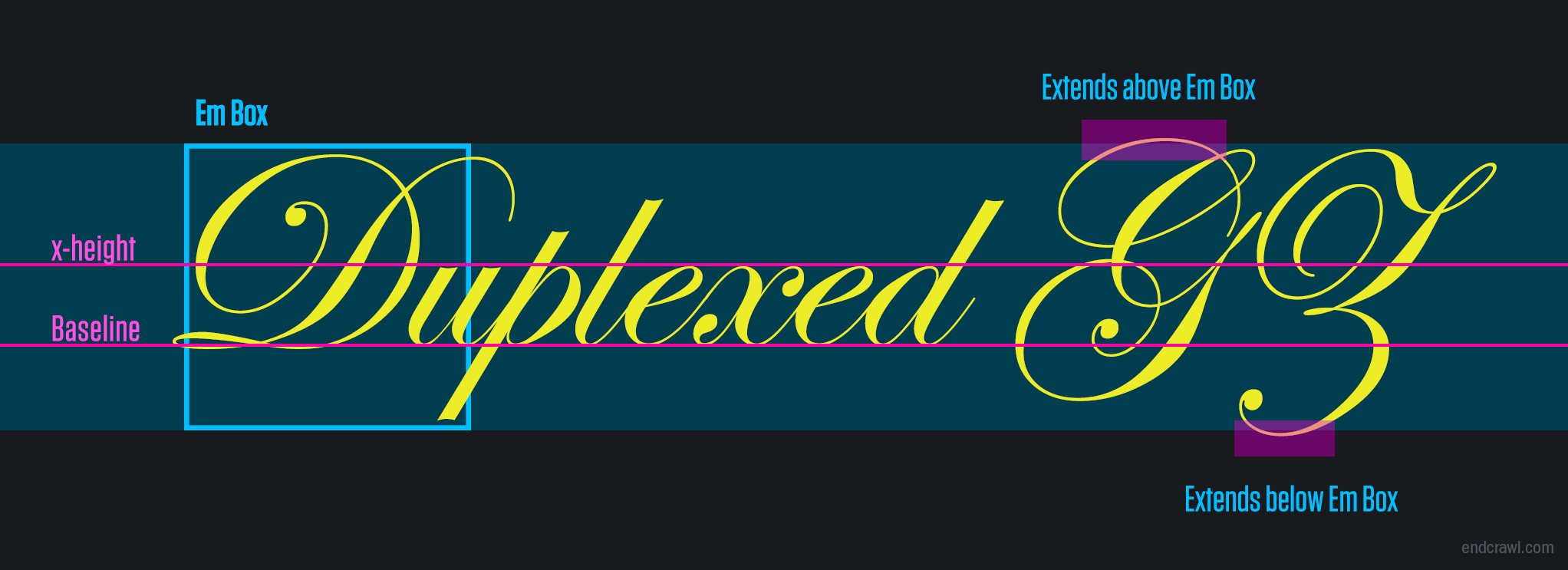
The em square != the bounding box of all glyphs. The em square is defined by the font's ascent & descent vertical metrics, which are set by the font designer.
There are reasons why you might want glyphs to escape the em square. Perhaps you're typesetting English text without accent marks above capitals, and using the bounding box's vertical maximum would introduce too much line space. Or perhaps you're using a decorative font which is designed to escape the em square, and potentially even overlap the em squares of lines above and below, like this: https://alangrow.com/images/blog/script-font-escaping-em-squ...
To make matters worse, and mostly for legacy reasons, there are THREE different sets of ascent & descent metrics in a font file. Which is used depends on your OS and the software rendering the font. But the Webfont Strategy described here is a nice one, because you can use the bounding box (winAscent & winDescent) if you really need to, say because any glyph might be used and you want to avoid em square escape: https://glyphsapp.com/learn/vertical-metrics
  # Proxy to a backend server based on the hostname.
  if (-d vhosts/$host) {
    proxy_pass http://unix:vhosts/$host/server.sock;
    break;
  }
Not a single command, and you still have to add hostname resolution. But you don't have to programmatically edit config files or restart the proxy to stand up a new dev server!
https://www.gallery.ca/magazine/your-collection/a-familiar-f...
Around this time my co-conspirator and I realized the library had 386s that almost no one was using for catalog search. They became our fractal render farm. We'd exit the catalog program, insert a floppy with our latest renderer, kick off a deep zoom, and turn off the monitors to avoid suspicion until we could check back next period. The results were thrilling. What a difference the access to compute made.
You all know the story -- eventually the librarian found us out and reported us for "hacking."
Got curious about this recently. I’m not great at citation tracing, but did make it back to this 1995 paper by David Eppstein [0] where he uses it to efficiently solve Subset Sum after an incremental update. Surely Knuth’s TAOCP had it even earlier?
The fact that FFT polynomial multiplication also lets you solve Exact Subset Sum with Repetition in sub-exponential time came as a real shock to me. [1] Crucially, this algo is O(N log N) where N = the maximum element, not N = the set size, so it isn’t a P ≠ NP counterexample or anything.
[0] https://escholarship.org/content/qt6sd695gn/qt6sd695gn.pdf
[1] https://x.com/festivitymn/status/1788362552998580473?s=46&t=...