

scandum
Joined 6 years ago
Karma
303
Submissions
70
Member since
Feb 26
Joined 6 years ago
Part of the problem may be that companies who own network infrastructure, and get paid for data usage, are also the ones that are the largest content providers.
This also comes with an electricity cost. We regulate efficiency for refrigerators, it might be time to add some sane limits to the largest content providers, which will also improve connectivity for those stuck with 2 Mbps.
It might work in combination with a software suite, with e-readers getting cheaper and more capable, and easily lasting through a school day, it's an option.
I suspect it has the same problem as ncurses: Not easy to learn, get proficient with, or rapidly produce something decent with.
I've been working on a project for a while that allows running any console program within it, and use text, keyboard, or mouse triggers to add a VT100 TUI, but it's uncomfortable to learn, very hard to get proficient with, and while it's possible to rapidly produce something decent, you're going to hit a hard wall producing something excellent.
I wonder what the archeological data looks like, 6 burned down houses and a very active imagination?
I wouldn't call random data 'complex', but it is easy to sequence when assembling short reads.
You'd save about 0.5 kwh a day in electricity, more if the AC is running. So I could see them becoming popular once the price comes down. People who run 2 monitors might be interested as well.
This reminds me of UK's 90% tax rate, which caused many multi-millionaires to leave the country.
Problem solved for the next 200 years.
Lithium batteries are over 95% efficient, so a long way indeed. Since the battery contains water, I assume it doesn't work below 0 C.
For me there's a strong visual component, perhaps most obvious for my work on array rotation algorithms.
https://github.com/scandum/rotate
There's also the ability to notice strange/curious/discordant things, and either connect the dots through trying semi-random things, as well as sudden insights which seem to be partially subconscious.
One of my (many) theories is that I have the ability to use long-term memory in a quasi-similar manner to short-term memory for problem solving. My IQ is in the 120-130 range, I suffer from hypervigilance, so it's generally on the lower end due to lack of sleep.
I'd say there's a strong creative aspect. If I could redo life I might try my hand at music.
As you can see, quadsort 1.1.4.1 used 2 instead of 4 writes in the bi-directional parity merges. This was in June 2021, and would have compiled as branchless with clang, but as branched with gcc.
When I added a compile time check to use ternary operations for clang I was not adapting your work. I was well aware that clang compiled ternary operations as branchless, but I wasn't aware that rust did as well. I added the compile time check to use ternary operations for a fair performance comparison against glidesort.
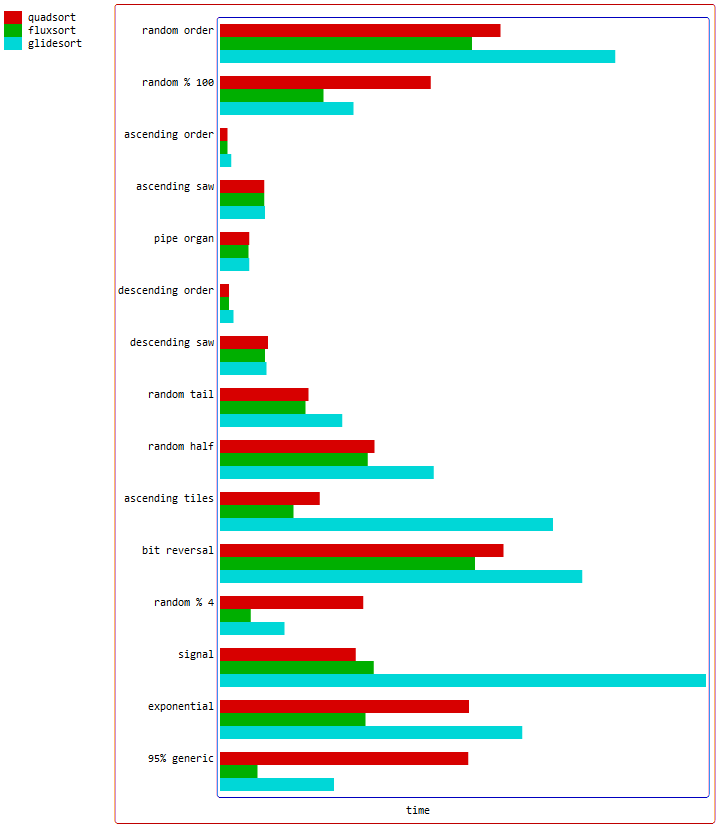
https://raw.githubusercontent.com/scandum/fluxsort/main/imag...
As for ipnsort's small sort, it is very similar to quadsort's small sort, which uses stable sorting networks, instead of unstable sorting networks. From my perspective it's not exactly novel. I didn't go for unstable sorting networks in crumsort to increase code reuse, and to not reduce adaptivity.
Like with web browsers, it is irrelevant what the standard states. The only thing that matters is that it displays correctly with the most popular / authoritative browser.