

s_gourichon
Joined 9 years ago
Karma
556
Submissions
260
Member since
Jan 12
Joined 9 years ago
Topic: "talking to the bomb"
https://www.youtube.com/watch?v=h73PsFKtIck (warning this is considered to spoil the movie).
``` #!/bin/sh N=20 msg_len=$(git log -1 --pretty=%B | wc -c) if [ "$msg_len" -lt "$N" ]; then exit 125 fi # Here you would run your actual test and report 0 (good), 1 (bad) as needed exit 0 ```
I encourage you to continue working on your projects.
Is it really possible to reconcile "no bloat" with "fully standard compliant"?
Maybe have a look at https://github.com/eyalroz/printf, if only for the test suite, which looks pretty comprehensive and still fails.
Maybe "key features" does not mean the same in all projects, making every project appear "unnecessarily bloated while missing key features" in every other context?
I had a bug:
u_printf( my_output_cb, NULL, "%d" NL, -42 );
--42
I may have found an explanation. In u_parse_format(), case 'i': calls u_itoa( value, buffer, 10, false ); which outputs minus sign.
Then if ( number ) does if ( sign ) { output_cb( '-', ctx ); chars_written++; } which outputs another minus sign.
25 years ago when I read that Microsoft has a software development environment named "Visual Studio" I imagined, well, something with graphs and nodes and flow and... Well something visual, right? Now it's 2024 and VS is still not visual.
Of course things are not as simple. Flyde (along with many alternatives mentioned) is visual IMHO. Keep up the good work!
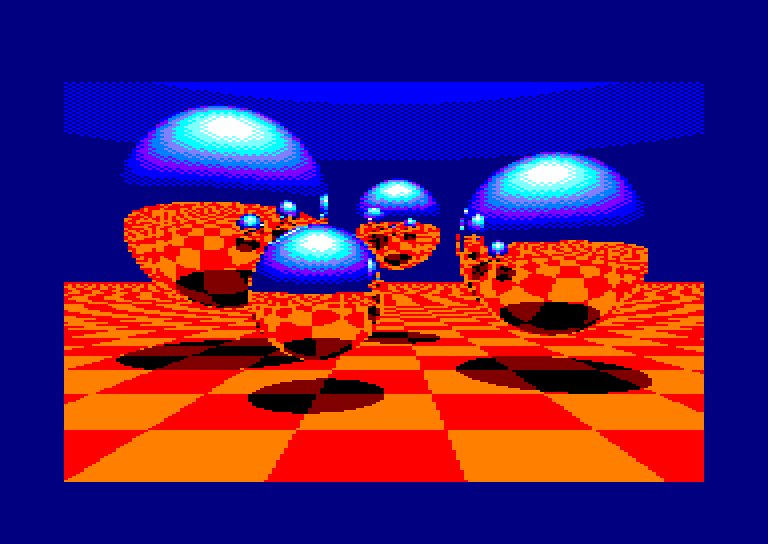
Well, you impressed me (and others) with your simple bet that "hey, what if I simply choose the two most popular colors" and just code that in simple BASIC. The same could be done with the shading. It would probably pick a good compromise when bright yellow meets dark red: by choosing to have the few should-be-red pixels become yellow, you avoid a bigger obviously-square-grid-based clash of colors.
Next step: error diffusion dithering would IMHO be a good bet. But maybe that becomes really to much for Basic.
I've been considering doing Raytracing on the Amstrad CPC, but in C. Perhaps using integers only, for speed.
Done that instead: https://cpcitor.itch.io/just-get-9
Hey, found this https://bbcmic.ro/?t=9ctpk via "BBC BASIC raytracer in 432 characters (mastodon.me.uk)" https://news.ycombinator.com/item?id=39023056#39023768
* colored spheres (like you did)
* (one) checkerboard surface
* self-shadowing (like you did)
* cast shadows (like you did)
* partial or total specular reflection!
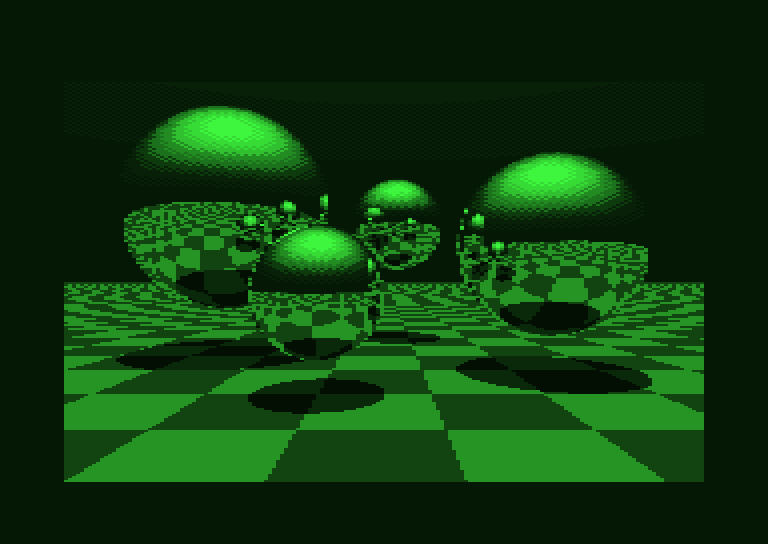
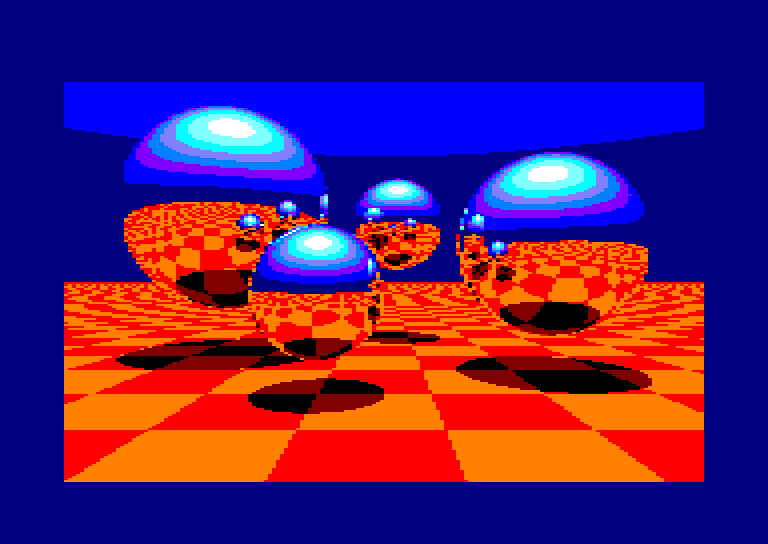
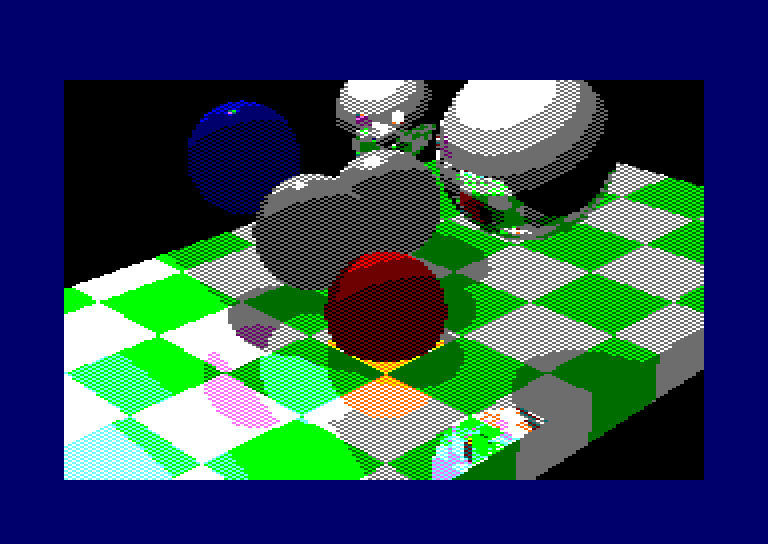
See https://www.cpc-power.com/index.php?page=detail&num=19283
The webpage displays the color (left) and green (right) versions on hovering your pointer over the ribbon (above). Image 1 and 2 are okay in both cases, image 3 is clearly tuned for color screen, image 4 for green screen.
Or direct links to the relevant variants:
https://www.cpc-power.com/extra_lire_fichier.php?extra=cpcol...
https://www.cpc-power.com/extra_lire_fichier.php?extra=cpcol...
https://www.cpc-power.com/extra_lire_fichier.php?extra=cpcol...
https://www.cpc-power.com/extra_lire_fichier.php?extra=cpcol...
https://www.cpc-power.com/extra_lire_fichier.php?extra=cpcol...
https://www.cpc-power.com/extra_lire_fichier.php?extra=cpcol...
Also, not exactly the same type or rendering, but basically word for word what you wrote: the full-screen fully animated parts appear to be "a set of frames rendered out and stitched together to make an animated sequence"
I've had the opportunity to use a variety of noise cancelling headphones over the years, from various brands, both in-ear and over-ear, and they all had this effect.
The good news is that you can become completely accustomed to it: after a while, the brain understands that there's no pressure imbalance, and it becomes a non-issue. Not hearing low frequencies is exactly what we expect from the product.
The article goes further to discuss some slope in a graph around 500Hz, which might be true, but I don't subscribe to that. It seems unnecessary to explain the observed facts and adds nothing.
What is not addressed at all is why all models seem to emit a subtle continuous shhhhhhh across a broad range of high frequencies. It's so subtle that you can only notice it when the outside environment is already quiet. I've never been certain whether it's just noise from the signal processing. My intuition is that it's artificially added to prevent inducing tinnitus in some users.
Yes, it's funny but that's not the point. The important thing is that the name clearly conveys the message that you really shouldn't be calling it, as explained in the comments above the function definition.
The "funny but there's a real reason behind" aspect is a bit like https://xkcd.com/radiation/ : "It's for general education only. If you're basing radiation safety procedures on an internet PNG image and things go wrong, you have no one to blame but yourself." The sentence is funny but has a real purpose: protect readers and author.


ParisTech engineer (École Polytechnique), Ph.D. in robotics, 15+ years industrial experience (including transportation and premises receiving general public). Missions for demanding contexts: consultancy, interim CTO, all missions dealing with software source code, with a strong bias towards very high quality. Freelanced for 10 years, now doing something else.
* Longer summary on https://www.linkedin.com/in/gourichon/ * Long list of experiences and technologies on https://fidergo.fr/expertise (French) * CV https://gourichon.org/stephane/cv (French) * Languages: English/French * Contact https://fidergo.fr/contact