mikelevins

Joined 16 years ago

Karma
2,293
Submissions
509
Member since
Oct 9
An eccentric old Lisp hacker who sometimes makes products (see the LearningTouch FirstWords games for kids), sometimes does contract work (see Franz, Inc. Clozure Associates), sometimes releases open-source code (see folio, Clozure Common Lisp, Apis), sometimes helps build startups (see Secure Outcomes, Inc., Reactivity, Inc. Centerrun, Inc.), and sometimes just plays games.
View on Hacker News

Recent submissions

Comment · 4 months ago
Probably, if I could contact them. But all the links I turned up lead me back to the captcha black hole, and the only email address I've found elicits a reply telling me that nobody is reading it. Perhaps something is reachable through additional effort, but I'm not particularly motivated to keep searching further. Perhaps someone there reads HN and would like to know this happened to someone, in case they want to fix it (for someone else's benefit if not for mine).
Comment · 4 months ago
I was interested in the Steam machine, but I might not get one because I cannot log in to my Steam account, for no reason that I know. Steam's web-based process for resetting my password always gets stuck after successful completion of the captcha, regardless of which device or OS I use to do it, the accessible-to-Google procedures for getting past that blockage have not worked, and the email address that one could once use in this situation now just sends an autoreply that says no one is monitoring it anymore.

So I have exhausted all of the obvious routes for logging into my Steam account. Perhaps there are additional routes to discover, but I'm not particularly motivated to look for them at this point. If just getting logged in is this painful, I'm not particularly optimistic about the experience of buying or owning the thing.

Comment · 5 months ago
In the early 1990s I worked on a couple of different projects at Apple that were done mainly in Common Lisp. When I was working on one of those, another of them hired a guy named Dave Vronay a young skater and assembly-language game-machine hacker to work on graphics and UI stuff. The Lisp we were using is the one that started as Coral Lisp, became Macintosh Allegro Common Lisp, then Macintosh Common Lisp, then OpenMCL, and more recently Clozure Common Lisp.

I remember stopping with a friend to chat with Dave one day not too long after he joined the team and he was over the moon about how the Lisp exposed not just an assembler, but an interactive assembler: he could write assembly routines, evaluate them, and see them run immediately, and also inspect the in-memory data that they operated on. He seemed so happy.

Comment · 7 months ago
It's going pretty well, though it took at least six months to get there. I'm helped by knowing the domain reasonably well, and working with a principal investigator who knows it well and who uses LLMs with caution. At this stage I use Claude for coding and research that does not involve sensitive matters, and local-only LLMs for coding and research that does. I've gradually developed some regular practices around careful specification, boundaries, testing, and review, and have definitely seen things go south a few times. Used cautiously, though, I can see it accelerating progress in carefully-chosen and -bounded work.
Comment · 7 months ago
Yes, I successfully fixed it. The fix was about ten years of regular practice of Chen style Taijiquan with good instruction. It’s not a quick, cheap, or easy fix, and it’s pretty hard to find good instruction, but it solved my problem.

It also seems to have solved RSI issues, but that’s impossible to prove.

Comment · 8 months ago
I'm finding that in several kinds of projects ranging from spare-time amusements to serious work, LLMs have become useful to me by (1) engaging me in a conversation that elicits thoughts and ideas from me more quickly than I come up with them without the conversation, and (2) pointing me at where I can get answers to technical questions so that I get the research part of my work done more quickly.

Talking with other knowledgeable humans works just as well for the first thing, but suitable other humans are not as readily available all the time as an LLM, and suitably-chosen LLMs do a pretty good job of engaging whatever part of my brain or personality it is that is stimulated through conversation to think inventively.

For the second thing, LLMs can just answer most of the questions I ask, but I don't trust their answers for reasons that we all know very well, so instead I ask them to point me at technical sources as well, and that often gets me information more quickly than I would have by just starting from a relatively uninformed google search (though Google is getting better at doing the same job, too).

Comment · 9 months ago
I've been experimenting with that from a slightly different angle: teaching Claude how to play and referee a pencil-and-paper RPG that I developed over about 20 years starting in the mid 1970s. Claude can't quite do it yet for reasons related to permanence and learning over time, but it can do surprisingly well up until it runs into those problems, and it's possible to help it past some obstacles.

The game is called "Explorers' Guild", or "xg" for short. It's easier for Claude to act as a player than a director (xg's version of a dungeon master or game master), again mainly because of permance and learning issues, but to the extent that I can help it past those issues it's also fairly good at acting as a director. It does require some pretty specific stuff in the system prompt to, for example, avoid confabulating stuff that doesn't fit the world or the scenario.

But to really build a version of xg on Claude it needs better ways to remember and improve what it has learned about playing the game, and what it has learned about a specific group of players in a specific scenario as it develops over time.

Comment · 1 year ago
Besides programming, my hobbies are writing stories, writing and recording songs, drawing, and painting. None of them needs to cost anywhere near $3000. Any of them can cost as much as you want.

Take the music hobby as an example. I have several expensive guitars now, but in the first 20 years of that hobby I probably spent under $1000 on guitars and related gear the entire time.

Comment · 1 year ago
I think the decline in UI quality is real, but I don't think the web takes all of the blame. The blame that it does take is due to a sort of mixed bag of advantages and disadvantages: web technologies make it quicker and easier to get something interactive on the screen, which is helpful in many ways. On the other hand, because it lowers the effort needed to build a UI, it encourages the building of low-effort UIs.

Other forces are to blame as well, though. In the 80s and 90s there were UI research labs in indistry that did structured testing of user interactions, measuring how well untutored users could accomplish assigned tasks with one UI design versus another, and there were UI-design teams that used the quantitative results of such tests to deign UIs that were demonstrably easier to learn and use.

I don't know whether anyone is doing this anymore, for reasons I'll metion below.

Designing for use is one thing. Designing for sales is another. For sales you want a UI to be visually appealing and approachable. You probably also want it to make the brand memorable.

For actual use you want to hit a different set of marks: you want it to be easy to learn. You want it to be easy to gradually discover and adopt more advanced features, and easy to adapt it to your preferred and developing workflow.

None of these qualities is something that you can notice in the first couple of minutes of interacting with a UI. They require extended use and familiarization before you even know whether they exist, much less how well designed they are.

I think that there has been a general movement away from design for use and toward a design for sales. I think that's perfectly understandable, but tragic. Understandable because if something doesn't sell then it doesn't matter what its features are. Tragic because optimizing for sales doesn't necessarily make a product better for use.

Comment · 1 year ago
It's called aging. Just wait until the first time you head back down the hall from the living room to the bedroom to get the thing you forgot to bring with you, get distracted for a moment by a pet or family member, and then can't remember if you were going down the hall to the bedroom or the living room.
Comment · 1 year ago
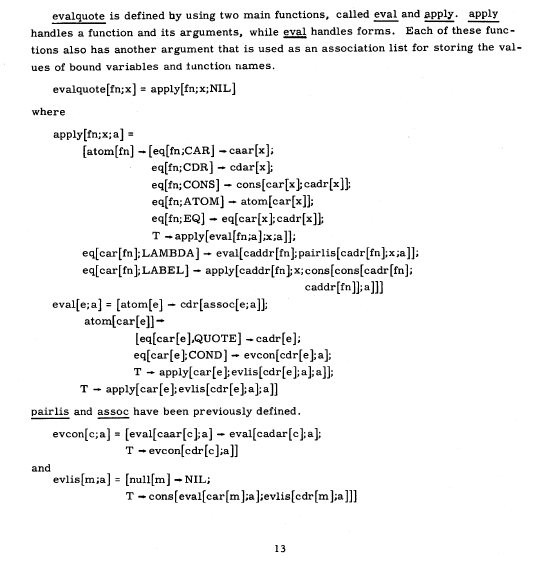
The essence of Common Lisp (and other Lisps) is the metacircular evaluator from John McCarthy's Lisp 1.5 Manual:

https://michaelnielsen.org/ddi/wp-content/uploads/2012/04/Li...

This is the half-page of code that Alan Kay famously described as "the Maxwell's equations of software."

Common Lisp and MACLISP before it and Lisp 1.5 before that worked by providing a running program that implements the functions given in that half page and applies them and their effects iteratively to their own environment.

In other words, the basic model is that Lisp is a running program that you modify interactively by feeding expressions to it one after another.

Common Lisp's model still works like that: when you give it a source file it reads one expression after another from the file, evaluating the expressions as it goes, and altering the running environment to reflect any changes that they make, such as adding new definitions, updating data structures, and so on.

The Lisp reads the next well-formed expression, converting it into Lisp data structures. It then evaluates the resulting data structure, yielding some number of values and updating the environment at the same time. (In Common Lisp even pure functions have side effects if evaluated by the read-eval-print loop because the standard defines a globally-accessible variable named * that contains the value returned by the most recently-evaluated expression).

Common Lisp's design reflects this basic model, and much of its standard library is concerned with making it convenient to work this way. The ANSI standard likewise reflects this basic model of computation, including features specifically designed to support this style of interactive programming.

The process of evaluation allows, but does not require, compilation. Common Lisp interpreters (usually called "evaluators") do exist, but most practical implementations provide compilers that compile each expression in order to evaluate it. Some implementations are "compiler only": that is, every expression is always compiled in order to be evaluated, whether it's in a source file or typed at a repl prompt.

To answer some of your specific questions more directly:

> is behavior when running a script in "interpreter" mode guaranteed to > be the same as when running in "native compiled code"?

"Guaranteed" is a strong word. ANSI specifies the behavior, and it's generally the same whether code is interpreted or compiled. That may be hard to achieve for some expressions, but if you find an example of different behavior, that's most likely a bug in ANSI compliance.

(I should allow for the possibility that the ANSI spec has some corner somewhere that allows for a difference, but I can't think of any off the top of my head. Of course, the spec is large and my memory is imperfect.)

> At what point does the compiler create an intermediate representation?

Depends on what you mean. Under some interpretations and in some implementations there may not be an intermediate form.

The normal lifecycle of an evaluation is:

- read: ingest text and convert it to Lisp data

- macroexpand: rewrite any macro expressions in the data

- eval: use eval and apply on the data to yield some result values

- print: convert the result values to text in a standard format and print it to *standard-output*

You might regard the result of the read function as an intermediate form, but I would say that what read produces is Lisp source code. In my view, the original text is not Lisp source code; it's a serialization of Lisp source code. Read converts the text into Lisp source code.

ANSI does not specify in detail exactly what eval has to do in order to yield results. It specifies abstractly what each function, macro, and special form is supposed to produce, and what side effects they are supposed to have on the running environment, but the details of how the code is generated and executed are up to the implementation. An implementation can simply walk the source code interpreting forms and producing the required effects; or it can convert them to some intermediate form such as bytecode and then let a byecode interpreter do the evaluating; or it can compile them directly to native code that does the evaluating when executed. These are implementation details not specified by ANSI.

One detail that is specified by ANSI is the expansion of macros. Macros are expressions that look like function calls or special forms, but which are implemented by applying a macro-expander function to the expression to produce a new expression that is then given to the evaluator. Macros may be defined by the system or by the user. They are expanded after read and before eval. The spec goes into some detail about how this process is supposed to work and what features of the language affect it.

> Why does SBCL not use LLVM?

LLVM's first release was 2003. SBCL's first release was 1999. Moreover, SBCL is a fork of CMUCL, which was first released in 1980, though that was before Common Lisp existed. It was called SPICE Lisp at that time, and the compiler rewrite that would turn it into Common Lisp happened about five years later.

The point is that one important reason that SBCL doesn't use LLVM is that it's a large mature codebase that predates the existence of LLVM by about 23 years. I'm not saying it would be impossible to port SBCL onto LLVM, but if you did it would be so much changed that it wouldn't really be SBCL anymore. It would probably also be easier to just write a new Common Lisp on LLVM (which is what the CLASP project has done).

> At what point are #-starting words(read macros?) evaluated and > how is that different from interpreting to compiling.

An expression that starts with "#" is, as you alluded to, a reader macro. What that means is that when the read function starts to read the expression it encounters the "#" and that triggers it to look up the next character in a table of special read functions. If it doesn't find anything it signals a READER-ERROR. If it does find something then it applies the found function to the input to read it.

For example, if you feed it "#'+" then it looks up the quote character in the table of reader macros and finds a function that converts the expression to "(function +)". When "(function +)" is evaluated it returns the function that is globally bound to the symbol named "+".

So the sequence is:

  "#'+" -> READ -> reader macro -> EVAL (function +) -> return the function bound to +
The details of what happens when a reader macro is executed depend on the reader macro bound to the specific dispatch character. A bunch of them are defined by the ANSI standard, but you're free to define your own, and it's up to you what those do. You just have to know that they will get called when the reader encounters "#" followed by whatever dispatch character you specify, and the output of the function will get passed to EVAL after you're done with it.

> How do I control the amount of optimization the compiler will do?

With the declaration OPTIMIZE: http://clhs.lisp.se/Body/d_optimi.htm#optimize

For example, (declare (optimize (speed 3)(safety 0)))

> Will the interpreter ever try to optimize?

The answer is implementation specific, and may not even make sense (for example if you are using a compiler-only implementation).

> Is garbage collection implementation-defined?

To a large extent, yes. The spec assumes that implementations provide automatic memory management, but I think the only directly-related feature specified by ANSI is the ROOM function. Every implementation I know of also has the GC function to trigger a collection, but I don't think it's in the spec. Different implementations also have different GC strategies, they may have more than one GC implementation, and they provide various different implementation-specific tools for inspecting and controlling GC behavior.


Comment · 1 year ago
And Larry Tesler, who was a particular champion of usability testing and important in the development of the Human Interface Group. Larry cared a lot about usability.

When I was at NeXT, Steve Jobs told me that if it was up to him, Apple would get rid of the Human Interface Group. (Steve was rather hostile to Larry.)

Later, when it was up to Steve, he did exactly what he said: he got rid of HIG.

I think it’s easier to sell visual design than it is to sell usability because people see visual design immediately, but it takes time and experience to see and understand usability (and some users never seem to consciously notice it at all).

Comment · 1 year ago
At some moments there has to be a singular decision taken, such as which of two possible options to take. In such a moment some particular consciousness makes the decision, if it’s a decision made by a consciousness (though consciousness takes credit for more decisions than it actually makes, I think).

But granting that point does not grant that there is a single consciousness that is always (or ever) in charge, and it does not grant that any specific consciousness is associated with any specific singular narrative.

We know, scientifically speaking, some things that call the idea of a single consciousness with a single narrative into question. We know, for example from psychology of testimony that the same person’s memory of the same events differs at different times, and that the act of remembering rewrites memories. We have reason to suspect that the brain attributes to conscious choice decisions that are made too quickly for sensory data to reach the brain (and which may therefore be made elsewhere in the nervous system, even though the brain claims to have made the choice after the fact).

And I know from personal experience that some phenomena that normally appear to be singular conscious experiences can devolve into something else under some circumstances. For example, I have experienced blindsight, in which I cannot see something but can nevertheless collect accurate information from it by pointing my eyes at it. I have also experienced being asleep and awake at the same time.

Experiences like these are hard to account for if I assume that my consciousness is singular and continuous and in charge, but not so hard to account for if I assume that it’s a useful illusion cobbled together by a network of cooperating processes that usually (but not always) work well together. For example, many people might claim that it’s nonsense to say that a person can be asleep and awake at the same time, but it’s nonsense only if asleep and awake are mutually exclusive states of a singular consciousness. If, on the other hand, they are two neurological processes that are normally coordinated so that they don’t occur at the same time (because it’s less than useful for them to do so), then it’s not nonsense to observe that under unusual circumstances that coordination might be disrupted. Similarly, if seeing something is one process and consciously experiencing seeing it is a different process—normally, but not necessarily coordinated—then blindsight is not so hard to account for.

Not to mention that it’s trivially easy to find examples of consciousness not being in charge of our behavior, although it likes to think that it is.

I suggest that the supposed singular consciousness, supposedly in charge, may be an illusion constructed by a system of mostly, but not perfectly, coordinated cooperating processes.

Comment · 1 year ago
How do you know there aren't several different consciousnesses that all think they are Peter?

How do you know they aren't just constructing whatever narrative they prefer to construct from the common pool of memory, ending up with what looks like a single narrative because the parts of the narrative come from the same pool and get written back to the same pool?

Perhaps each consciousness is just a process, like other bodily processes.

Perhaps a human being is less like a machine with a master control and more like an ecosystem of cooperating processes.

Of course, the consciousnesses like to claim to be in charge, but I don't see why I should take their word for it.

Comment · 1 year ago
What makes you think a singular consciousness controls the body?

Live from the official Hacker News API

A modern reader for Hacker News · SvelteKit + Skeleton