mark_round
Joined 14 years ago
Karma
276
Submissions
60
Member since
Aug 2
DevOps architect and retro-computing enthusiast. Check out https://markround.com for my Amiga and ZX Spectrum related projects!
View on Hacker NewsJoined 14 years ago
When I said "stock" I really meant a basic 128K/+2/+3 machine and not one of the interesting Soviet/Eastern European clones with advanced capabilities that some portions of the demoscene adopted.
  I’ve been thinking a lot recently about what it is exactly about the Amiga that captures me in a way that no other computer ever did. Part of it is I think because the Amiga was the last system that was simple enough that one person could reasonably hold the entire machine in their head.

  It was complex, true, but with enough studying and time you could know pretty much everything about every single bit of the Amiga’s memory space, workbench, the custom chips and so on. That’s what makes it so special and endearing.

  That simply doesn’t exist on other platforms. I mean modern systems are amazing - and I’ve worked on some serious big-iron hardware in my time - but you could spend an entire lifetime now simply becoming an expert in one tiny piece of the whole system. Modern computers just don’t have the accessibility that the Amiga had, and it straddled the divide perfectly between being simple enough to know it and love it, yet powerful enough to do things you’d never dreamed possible.
I love the crowd reaction. Would have loved to have been there. There's some great behind the scenes details here: https://iquilezles.org/articles/function2009/
One of the uncomfortable realities I've encountered being involved in the retro scene is that so many of the resources are slowly disappearing, either because the original authors age out of the scene or loose interest (or sadly, many are approaching that age where natural causes are taking them from us), old companies are long since defunct and resources slowly disappear into a legal quagmire or no-one ever thought to archive them in the first place.
DN42 is a great playground for this thing - as long as you're prepared to put the effort in, it's a very friendly and helpful community. It's fun to build things for the heck of it and there's a lot of weird and wonderful stuff being worked on there.
After getting started with the various "auto peering" systems, I've been making much more of an effort to find individual operators[1], and add myself to the peerfinder and hang out on IRC.
It really does feel like the "old internet" and while the technology and learning opportunities are great, it's the people that really make the network.
[1]=If you're interested, I'm more than happy to peer with you - details at https://markround.com/dn42
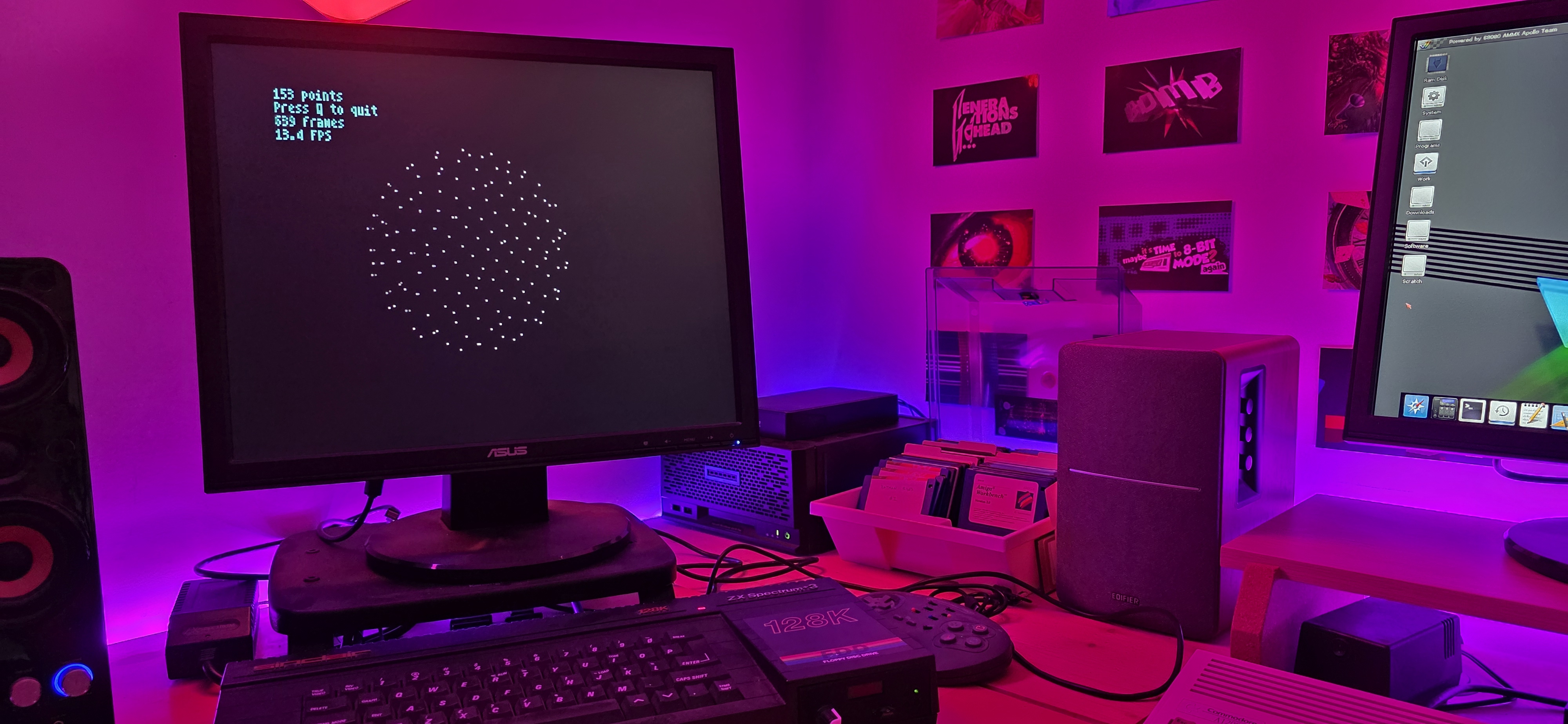
https://share.markround.com/sphere.jpg
I have also uploaded it to my TNFS site[1], which you can also access through an emulated Speccy in a browser (or a real Spectrum if you have a Spectranet/Spectranext card fitted):
https://jsspeccy.markround.com
Press option 4 on the main menu when it loads for recent uploads.
It's really cool and very, very smooth. I wasn't quite sure what to categorise it as on my site, so I filed it under "demos" as I think it's a very impressive bit of code :)
Thanks for sharing!
-Mark
[1]=More details at https://tnfs.markround.com or on my "DevOps for the Sinclair Spectrum" series of articles which are linked from both sites.
Let's Encrypt has become one of those pieces of critical Internet infrastructure that just quietly hums away in the background, the fact that they've stopped ALL issuance is deeply concerning.
There's always been a tendency amongst the "priesthood" of any in-group to hoard knowledge and use it to maintain their position. So, regarding the "democratizing" of creating software - I mostly agree with you, and also agree that it's probably a good thing. I think it's pretty neat that someone without any coding experience can create their own bespoke tooling to solve a problem. I have caveats and concerns, but that's a topic for another day.
I also agree with the "that's art" part of your comment. I learned to program by reading other people's code, learned to build infrastructure by watching what my peers were doing, and learned to play an instrument by listening to and copying musicians I admired. Heck, I play in a covers band!
The problem is that this isn't just someone being inspired to create their own thing and put their own spin on it, which could be cool.
Even "nice idea, I'm going to do that and see if I can charge for it" isn't really an issue, free market and all that. This is cloning and copying on an automated, industrial scale, apparently sometimes for malicious, criminal purposes too.
That's a far cry from creative copying of ideas.
I posted more or less the same thing in a comment over on lobste.rs[1] - being able to create your own bespoke software tools, without any developer experience is (mostly) a really cool thing.
This isn't someone being inspired to build something: It's the automated "drive-by" cloning and scammy, dubious nature of these clones that bothers me along with the copying of personas & identities to spam them across social media.