

leovonl
Joined 11 years ago
Karma
163
Submissions
73
Member since
Jan 12
Joined 11 years ago
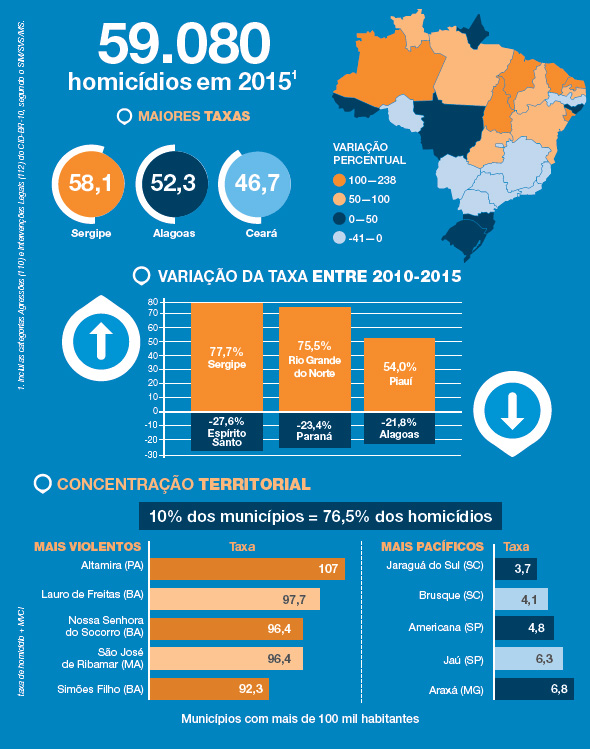
Northern region has places with 60+ homicide rate, southern region has places with 3-4 homicide rate.
Take a look at this article: https://pt.m.wikipedia.org/wiki/Lista_de_unidades_federativa...
And this map with some of the highest/lowest homicide rates: http://55ca7cd0-f8ac-0132-1185-705681baa5c1.s3-website-sa-ea...
Both in Portuguese but I think it's not hard to make sense of the numbers (rate is 1/100k, map colours describe increase/decrease in violence, bottom lines show current top/bottom rates in cities with 100k+ residents).
OCaml itself is not a new language and they are probably not going to break compatibility to fix minor syntactic issues now - even the new ppx system was introduced in a way to not interfere with the current syntax. TBH I find it a very minor annoyance compared to all other more things the language has to offer.
Entering in ketosis was also an watershed moment, like an epiphany, with a sudden feeling of increased awareness. But it's hard to describe precisely, and I guess YMMV.
The brain depends on a very small quantity of glucose to function - it arguably is more efficient with ketone bodies, for instance [1] - so covering not only glycolysis seems like an incomplete research.
[1] https://blogs.scientificamerican.com/mind-guest-blog/the-fat...
In case of ketosis [1], the brain mainly relies on ketone bodies for fuel.. I'm curious about how one's brain would perform in such state - judging by personal experience, the results would be very different.
I have a number of services running at home, all outside the standard ports - sip is on 5099 (remote gateway is on 5088), SSH on 5225, etc - and the difference in the number of attempts to log into my box (and make international calls..) is huge - actually, I did not have a single attempt to put a call through my asterisk box since I changed the ports outside the default range.
Of course, it's not the only security measure, but I'd argue it can be as important and as effective as any other.
In fact, I think most brazilians of my generation which share same taste for building things are used to prototyping things with "a lot of duct tape" and reusing parts by disassembling unused/old toys, small machines/appliances, etc, and reusing what they can to make something new.
About the "gambiarra" term, it has a lot of connotations associated (some bad), but it also carries an idea of "subverting the original intent of the designer" or "subverting the intended usage of the parts/pieces". Which is why it fits perfectly in the idea of "hacking" for repurposing and recycling.
This tells a lot about what is wrong with software development and why industry is constantly plagued with security issues, misbehaving systems, buggy behaviour on edge-cases, etc.
There was a thread on HN some time ago about software engineering, and I remember mentioning that if "software engineering" was really to be taken seriously, we'd be using theorem proving to guarantee software is correct.
The best analogy is the bricklayer vs structural engineer: you can build something simple very quickly without really putting too much thought about soundness, but once you go past a few floors the risks are too big to be ignored - which is why we have the latter.
It usually boils down to cost - some people like to spread the idea that formal methods are sorcery or are limited in scope, specially people outside of computer science that have no strong background on mathematical methods, which sometimes do a disservice to the efforts of researchers and the ones that had exposure to the theoretical foundations of CS.
In any case, I don't want to go on a huge rant here - so if you don't know, it doesn't hurt to spend some time reading about modern tools and applications for this, maybe even playing with available tools, and.. who knows, maybe learn something new.
I can think of two very strong reasons to prefer awk over perl:
* busybox implements awk, so its (usually) available even on embedded platforms
* awk syntax is way clearer than perl, anyone that has a few experience in C + shell can figure out what is being done with some googling
awk is also powerful enough to separate output to different files, accumulate inputs, etc. And if you need anything more complex, there are tons of other languages to choose from then (including perl).
And not only that, but they did much more than the average Joe and essentially pin-pointed the issue for them. So yeah, inexcusable it is.
Real "software engineering" would have to be done with Agda, Coq, or similarly tools - theorem provers that guarantee your solution is sound. It is done that way for software that absolutely cannot fail (eg, aerospatial). Unfortunately, engineers are usually too far away from this kind of knowledge - and sometimes even doubt this is possible or doable, even if you direct them to the research (!).
By the way, software engineering disciplines are usually depressive OO garbage, frameworks and all that non-sense that comes with excessive Java usage, and frankly never teach anything about reliability or even proving programs correct - which should have been their primary goal.
First, declarative programming is a generic name which includes a broad range of paradigms - from functional to logic programming. Logic programming is something that deserves a special mention and discussion, because there are a number of interesting and unique concepts that deserve a more in-depth explanation.
Second, "dependent types" is better understood as a feature of a language (or better yet, of a type system) than a paradigm by itself.
Some of the other "paradigms" also seem more like characteristics of languages, and not really something that structures the way solutions are expressed/understood.
Context: I'm from the Itajaí Valley (where Brusque is located), which has a strong textile industry - one of the main drivers of the local economy. It used to be much stronger until the disastrous Collor government caused a number of them to go bankrupt or severely reduce their production due to some serious mismanagement of the Brazilian economy.
Edit: His original employment contract can be found here (in Portuguese, a bit difficult to read): https://www.brusquememoria.com.br/acervo-imagem/2057