
jeromescuggs
Joined 7 years ago
Karma
39
Submissions
32
Member since
Apr 23
just
View on Hacker NewsJoined 7 years ago
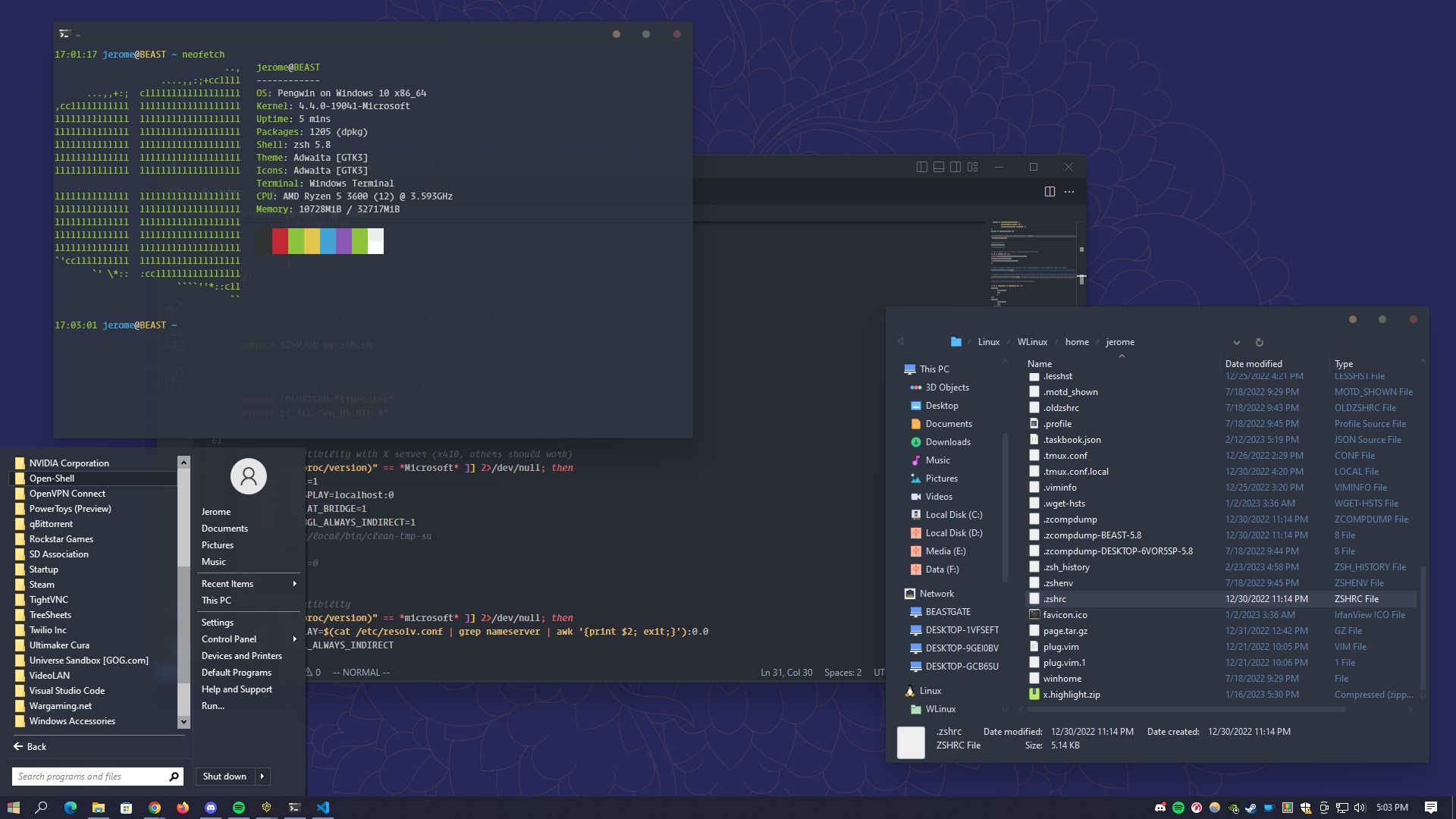
windows 10 + open-shell + powertools + wsl + windows terminal is a really great combination right now
for me, windows 10 essentially functions as a login shell/window manager for my linux environment that comes with the best version of WINE i've ever used https://ha.zardo.us/img/ss21022023.jpg
using linux via wsl is incredibly straightforward, to the point that you don't see alot of WSL-specific instructions on e.g. installation/compiling readme's.
i think i read the phrase "emacs envy" more than once, i just feel like OP has a very specific audience for this post in mind
i distill concentrates for a medical marijuana cultivator in a part of the country where it's still a real cointoss on how ppl her age feel about that
tl;dr: the russians are demonstrating the failure of a particular strategy/theory on how to deploy and use armor, not a failure of the concept of armor itself.
a mobile, armored vehicle capable of things like transporting infantry and serving as a mobile defensive position to fall back to, engaging enemies with direct or indirect heavy fire, serving as a command and control vehicle, etc
the line between "tanks" and IFV's seems to be getting blurrier, because the idea of a relatively heavily armored, big-gun, "breakthrough" tank really is a relic of cold war strategy. the past few decades have seen tank designs evolve to become more mobile and even capable of carrying infantry. at the same time, 'infantry fighting vehicles' are becoming more armored and carrying higher-caliber main weapons.
tactically, an armored vehicle appearing on a battlefield is still advantageous: you've immediately aggro'd the enemy forces and allowed your own infantry to breathe for a second while the enemy figures out how to deal with the armor. you could bait out hidden antitank elements. you could mount some powerful optics and a radio, and you can have a commander remain close to the elements they are directing, while relatively protected. you could use heavier armor as line-of-sight howitzers to clear urban environments.
what's changed is it's now a real bad idea to send in heavy armor as a 'spear tip' in an invasion, you want to support them with infantry, and at the point where you're forced to mix armor and infantry, your armor will begin to resemble more infantry-friendly designs. the example probably most familiar with folks is the israeli merkava tank - for all intents and purposes it's a 'main battle tank' but it can also carry 6 passengers in a rear fighting compartment, which i imagine allows for some really flexible fire-and-maneuvering.
in the context of the russia-ukraine thing, all of this flies out the window; i have no idea what the russians are doing. partly because of the fog of war but partly, from what i can gather, because their military was kinda dogshit going into this conflict. i swear to god it's like they've unlearned stuff since 1988.
i think a part of that was also realizing what drew me to frameworks initially was less about styling and more about the grid or flexbox etc scaffold - the most daunting part for me to this day. creating my own set of base templates helped me learn quite a bit about grids though, and now when stuff breaks i can tackle it with more confidence in where to look for the issue and how to go about fixing it.
that being said, i'm not anti-framework or anything - i relied on them alot as i learned CSS, and even now i still treat them like something akin to styleguides or catalogs of what's new/trending in webdesign
echoing the other comment: with the caveat that i've always had a basic familiarity with css/html, i wound up throwing everything out and just building my own theme up from scratch. the real headscratcher is figuring out the whole grid/flexbox div positioning stuff, but from there it's not super tough to look at website source code for ideas, and/or google around.
it kinda seems like you're shooting for a solution in which you'll find exactly what you're looking for without having to pay a designer or even put in some time on google. in my opinion, learning css was far easier than learning how to properly maintain a static site - so it kinda threw me for a loop. on top of that i'm not really sure what you mean by 'quality' and 'finesse', except that from all possible existing designs, i can safely exclude 'most of the ones of jamstackthemes.dev'
my guess is there's a factor that affects the system you described: centralization. it's something i think about alot when i sort of try to look back and remember how i stayed on top of so much content back in the pre-web-2.0 times. i remember something like you describe - lotta reading copy, sure, and landing pages definitely, but the huge difference in my mind is how 'influencers' were more of a complex ecosystem of people who just sort of passed interesting links to other people. i dunno.
Personally, 'despise' is perfectly descriptive. Fortunately I've always done dev-related stuff as a tinkerer's hobby, unfortunately my discomfort at shameless self-promotion will likely mean I won't be quitting my day job anytime soon.
unfortunately, as we see currently, simply dismantling narrative itself doesn't seem like a solution to anything, because narratives are more or less the very thing which have driven so much of our history.
you sort of touch on the vital task: making a satisfying story out of what we're going through. the challenge is always finding ways that this story won't justify or entrench shitty elements of society. (one might even say we are in the process of challenging a narrative concerning the role of police)