erostrate
Joined 12 years ago
Karma
1,022
Submissions
140
Member since
Dec 15
Joined 12 years ago
Should you push arguments that seem ridiculously unacceptable to the vast majority of people, thereby reducing the weight of more acceptable arguments you could possibly make?
I'm not saying there's anything wrong, and I'm oversimplifying a bit, but I still find this amusing.
If my end goal was to apply this to everyone at some point, I would probably start with such a restricted law, then extend it step by step later.
Travelling 6 miles (9.7 km) by motorcycle
Travelling 17 miles (27 km) by walking
Travelling 20 miles (32 km) by bicycle
Travelling 230 miles (370 km) by car
Travelling 1,000 miles (1,600 km) by jet
Travelling 6,000 miles (9,656 km) by train
But switching from car to bicycle for short trips still increases life expectancy due to health effects.
Sources: https://en.wikipedia.org/wiki/Micromort https://www.ncbi.nlm.nih.gov/pmc/articles/PMC2920084/
Certainly agree. The point is that coming up with the idea, writing it as an equation, or an architecture diagram in a paper, is a small fraction of the effort that goes into making the idea work in a model showing good performance on real life datasets.
For example, just taking a random paper that Schmidhuber claims should give him credit for GANs, https://people.idsia.ch/~juergen/FKI-126-90ocr.pdf hopefully you can easily see that a lot of work would be needed to turn this into a realistic image generation model. And that is, even if you admit that the idea is strongly related to GANs, which I'm not convinced of but won't spend time on.
> Credit belongs to whoever actually makes it work. >> That is according to whom? Is it a rule you just came up with or accepted practice? And if it's accepted practice, in what community is it accepted practice?
It is accepted practice in the ML community. If it weren't, Schmidhuber wouldn't be complaining.
- Gary Marcus
- Juergen Schmidhuber
- Pedro Domingos
- Max Tegmark
- Eliezer Yudkowsky
Some context for people unfamiliar with ML research: the author, Schmidhuber, is well known for claiming that he should get credit for many ML ideas. Most ML researchers think that:
- He doesn't deserve the credit he claims, in most if not all cases.
- There's a few cases where his papers should have been cited and weren't. That's fairly common.
- People do not get much credit for formulating an abstract idea in a paper or implementing it on a toy problem. Credit belongs to whoever actually makes it work.
- Credit assignment in ML is not perfect but roughly works.
Amazon, Apple and Google are all working on incorporating LLMs but why is it taking so long? Why are these assistants still so bad? ChatGPT has been available for a year, GPT3 API for 3 years. I suspect some of it is legacy tech and legacy researchers from the pre-LLM era.
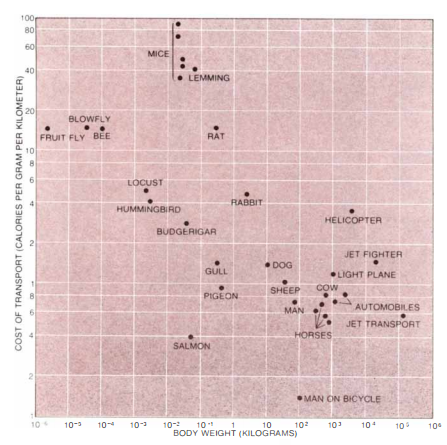
They are both Pareto-efficient. Here's a chart of cost of transport (calories/gram/km) vs weight (kg) comparing a salmon vs a bicycle vs a jet fighter etc: https://www.bike.nyc/wp-content/uploads/2017/04/efficiency-g...