

_xivi
Joined 2 years ago
Karma
1
Submissions
459
Member since
Jul 29
Joined 2 years ago
How can you possibly have this assessment without looking at the code/infra?
There are many things that affect cost beyond the visible features. The project isn't in a vacuum. It's interlocked with their other services infrastructure.
You can judge Google however you want, but they're not stupid or amateurs. These types of announcements immensely damages their image and affect their customers, if they could avoid it easily as you imagine, why would they not?
They've built the service and run it for many years for billions of people. A more realistic guess would be that for whatever reason, the price is higher than what's visible on the surface and they're not willing to pay it.
Related discussion (2 days ago): https://news.ycombinator.com/item?id=40998549
Discussion of the previous announcement in 2018: https://news.ycombinator.com/item?id=16719272
  1- Always longer than necessary with a lot of fluff

  2- Favor lists and hierarchy
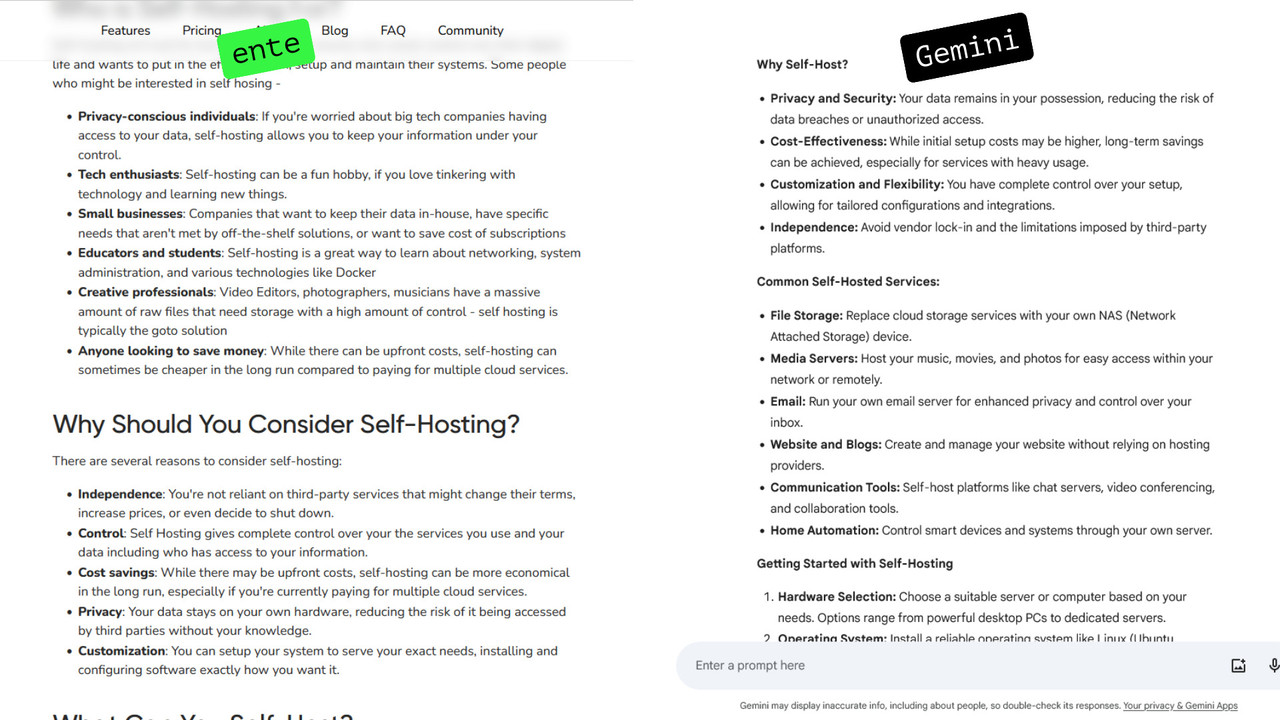
I asked Gemini to "write an article about self hosting" and the output structure and content is eerily similar
Here is a side by side comparison: https://i.postimg.cc/kXXpWgnZ/why-it-look-like-LLM-generated...
Not OP, but they said the following in an answer to similar question: https://news.ycombinator.com/item?id=40940707
"The technology is extremely flexibile, off the top of my head:
* Education (Linux, Programming, Security, ...)
* Live docs for arbitrary languages and binary libraries
* Preservation of historical software and games
* Virtualization of legacy Windows enterprise apps.
* Dev environment for Web IDEs
Just a few examples, the list could go on for long"
I'm also reminded of Mike Tyson's quote: "Everybody has a plan until they get punched in the face".
Things rarely go as planned, so you should favor following leads and taking advantage of opportunities, instead of sticking rigorously to some plan you put together when you were less experienced.
Unless there's evidence the original plan is still viable, oftentimes, being attached to it and ignoring what's the market is telling you is just your ego speaking.
If anything that goes against the parent comment, how Apple has more revenue per engineer while not being a feature factory by any stretch
In any case, taking both of the comments combined kinda prove my point, that higher revenue can be attributed to many things completely outside how many products/features was shipped:
- Pricing strategy
- You can have a monopoly with a single shitty product
- You can be middle man/broker with no product to begin with
- You can be running a Ponzi scheme or committing fraud
So it doesn't make sense to use revenue (or revenue per team member) as a way to compare teams between different companies and furthermore possibly across completely separate markets and industry
You can have millions of dollars in revenue without producing anything, on the other hand, you can also provide a lot of services and products for free
This is like saying your evaluation of my property, back when it was in bad shape was wrong... because after renovating the entire thing and fixing its issues, I got a different price.
From the linked article:
> Is there some way Microsoft could come back? In principle, yes
So, of course if you manage to change the input, you'll get a different output.
Today's Microsoft (WSL, Edge, Bing, Azure, VSCode, copilot, etc) is so different from 2007 you wouldn't even recognize it as the same company. Just like what Paul Graham has said they needed to change if they were to survive.
What's on the approved stack? I imagine .Net and Java/spring are the standard, right? anything else like php, python, go etc?