Spearchucker
Joined 15 years ago
Karma
3,208
Submissions
1,183
Member since
Oct 5
fourthprotocol at wittenburg dot co dot uk.
View on Hacker NewsJoined 15 years ago
OMG you worked on that? The blame for this one (and Universal Credit) sits with GDS. Their approach at the time was agile or die, and then try to develop an enterprise system like they did the Guardian's CMS (GDS was staffed initally by ex-Guardian devs).
I had the misfortune of reviewing their Government Gateway replacement, which at the time focused singularly on identity federation. GDS was hugely anti-Microsoft, who built the Govrernment Gateway. And so they chose the SAML protocol over the incumbent ADFS, breaking every dependency.
GDS was way out of its league. An inexperienced 25y/o will draft exactly the kind of architecture document you describe.
I feel for you, and I now understand the cyncism.
https://www.wittenburg.co.uk/Work/Books.aspx
The one that made the biggest impact on my approach to architecture is "Designing Solutions for Your Business Problems: A Structured Process for Managers and Consultants" by Betty Vandenbosch.
The one that made the biggest impact on me in ever is "Wicked Problems, Righteous Solutions" by Peter DeGrace and Leslie Hulet Stahl. Lots of forehead slapping and kicking myself ensued. Even more applicable today than it was in 1990 when written.
"Peopleware: Productive Projects and Teams" by Tom DeMarco and Timothy Lister comes as a very close second.
Not directly architecture or technology-related is "The Story Factor by Anette Simmons". It... changes you. Really useful for technical writing.
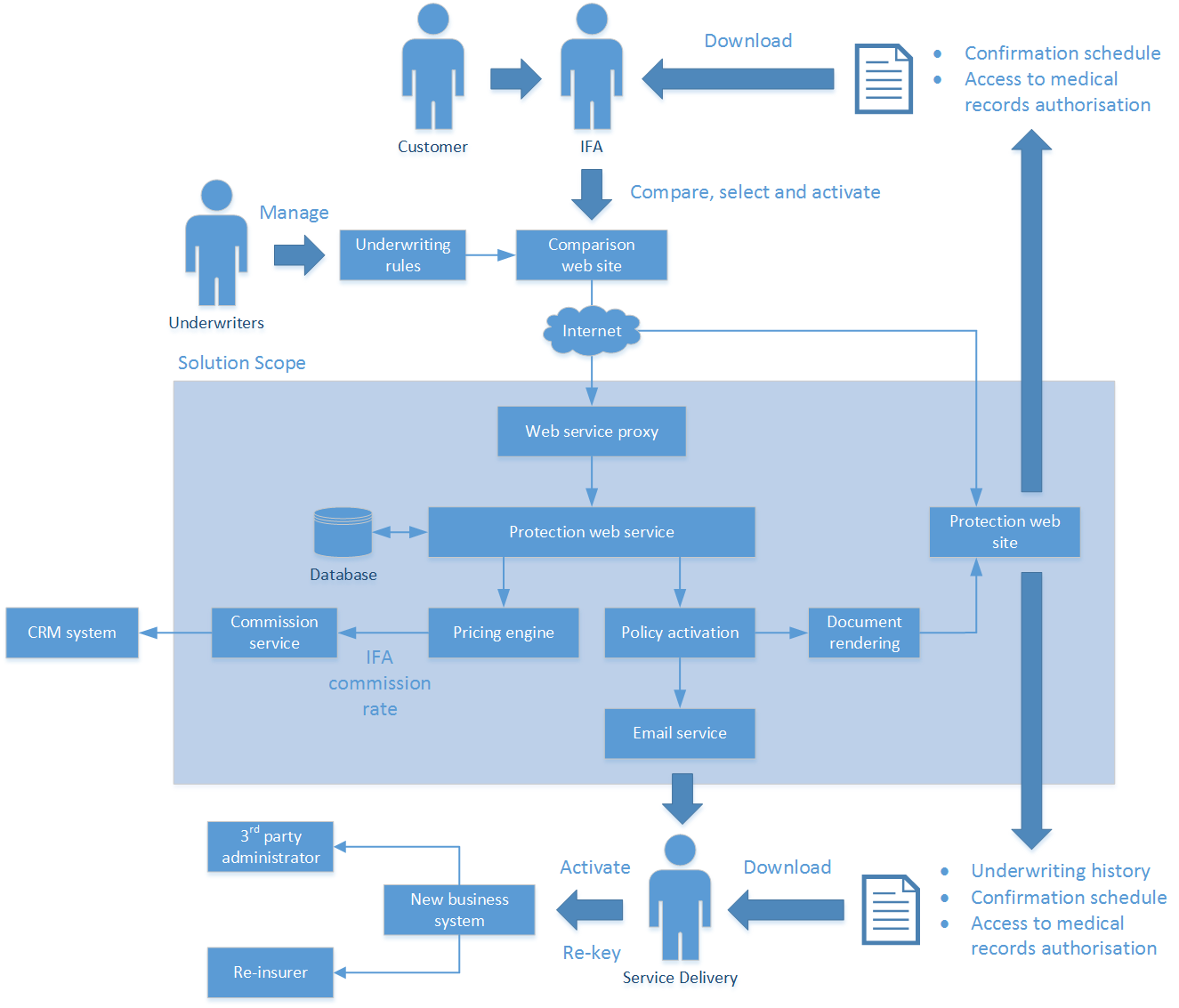
By way of example - here's a conceptual design for an insurer wishing to participate in a panel of protection providers.
https://www.wittenburg.co.uk/images/consulting/conceptual_de...
If you're in this world all of it is self-evident, none of it a surprise, and you understand the flow. That document leads to other more detailed designs that each address one distinct rectangle in that image.
At some point all of this will become a specification. Again the immensity of that depends on the ability of the authors. On their ability to manage complexity, and their skill as technical writers.
Either way yes, when the wheels fall off that document becomes the truth, the one everyone goes to to settle disputes. And with a capable team it never gets to that because the documentation is succint and agreed to, and what is delivered matches what was specified.
People don't consider using my project. There's a client with a business problem, there's a vendor who solves problems for clients. The vendor produces an architecture document that describes how technology will achieve a solution †.
There is no noping the fuck out, as this is a hospital asking you for a one-off to manage/settle insurance payments. Or an electoral district asking you to merge three emergency response systems into one. Or Nokia asking you to tariff calls going through a switch in real time.
† This is nuanced. Often a client's procurement department invites a number of candidate vendors to submit proposals including a design proposal/architecture and associated cost estimates. Vendors range from the high end (McKinsey, Bain & Co, Ernst & Young) to the mid-tier (Wipro, Accenture and so on) to the niche.
Typically I try to start with tiers (1, 2, n-tiers...?) that show how the system might be deployed. I then list list layers (user/facade/business/data), interfaces between these layers, and components within each layer. I do that for each tier.
After that maybe something about quality objectives and how they might be met, eg: availability (MTTF / (MTTF + MTTR) * 100), efficiency, flexibility, integrity, interop, usability and so on.
This leads to a physical delpoyment model, which shows layers deployed to tiers. And yes, I'm rather fond of Visio.
Then a bit about approach (dev/deployment and operational management) risk and stakeholder management, technical reviews (change control board maybe?), and project reviews.
To be fair I come from a predominantly critical systems world (telecoms OSS and BSS, healthcare, transport and some fintech. And in that world architecture is very far removed from actual code until eventually.
Also, many attacks today target security protocols rather than, for example, cracking passwords.
Another huge impediment to creating secure systems is agile, which discourages up-front design. The average sprint duration of two weeks is too short for meaningful security testing. Testing is not feasible with nightly builds or pre-release sanity checks, either.
Product owners or customer representatives are too often non-technical stakeholders that have the authority to make technical design decisions. While never a good idea, this has bad consequences on architecture and particularly on security.
I taught myself to program in 1984, two years before finishing high school. That and being on the chess team pretty much killed my social life and any chance at carnal activities until I turned 21 (high school was followed by compulsory consription for 2 years). I struggled with that.
Today I note that impressing friends and strangers has become very big business. Influencers. Looked at one this morning on Instagram. This dude had muscles, gave thed impression of owning a Bently, a curvy girlfriend and a house in Majorca. No clue as to how he eant a living or obtained that wealth. Assuming those material posessions are his.
These things are the antithesis of what I went through, even though today I have the means to aquire everything from the Bently to the large-breatsed blonde in a house on the Costa Del Sol.
And yet that prospect fills me with dread because it's vacuous. There's no meaning or value behind it. Same goes for teaching someone something for the purpose of becoming popular or impressing others. Seriously please don't take this as criticism. ANY time spent with kids is time well spent.
I guess where I'm going with all of this is that I hope to teach my 8y/o boy to seek out meaningful, rewarding relationships and experiences that build him up. Without a need for others' approval. And I have vague ideas how I might do that but in a practical sense I'm at a loss and that scares me. And I would LOVE to teach him how to program but so far I've made no progress.
Part of being a dad I guess. Happily I've discovered that if I want a thing enough I find a way. Patience...
Of course .NET can be replaced by anything that supports async, non-blocking functions.
If instead I used message queuing instead of writing the code myself I'm adding yet another configuration item to my system, replete with security holes, patches, operational management, and sourcing the skills to procure, install and run it. Of course each has idiosyncracies you need to learn and understand - like Rabbit's memory-based queues. When the instance goes, so potentially does reliable messaging.
I'm very much not a fan of message queues. Haven't been for a good many years.
"Anger treats its target as someone capable of recognizing that she has done wrong... "
This is true in some cases, but not all. Had a girlfriend once who used anger to get what she wanted. It was like cash to her - a simple means to an end.
When I pushed back it spiraled into abuse. She became ever more hurtful instead of being conciliatory tory. Blew my mind.
I'm firmly in the camp that seeks to eliminate all anger from my life, and avoid it in others. Like the plague.
That said, apparently they've just reached a deal, and the transition period ends in 7 days, so lets see what they decided about with data protection.