

Recent submissions

Comment · 7 days ago
Which browser do you use? Unsurprisingly supporting media print queries hasn't been top priority for some browsers. It makes total sense, but when you suddenly need it for something it does suck.
Comment · 1 month ago
I guess "necessary" was a bit too vague of a word. I meant that for all your various requirements such as quality, style, workers conditions, etc. there is a cost included. If I gave you the same shirt, from the same brand, created by the same people, but gave you two options for price you'd choose the lower one. If I gave you one shirt at a high price and one shirt at a low price you'd need the higher priced shirt to be justifiably more expensive.
Comment · 1 month ago
> Major known brands are guilty of this too, often regardless of price.

I think this is part of the problem. Everyone wants high-quality (for the most part), but no-one wants to pay more than necessary. If known brand is no longer an indicator of quality, how do you determine that you want to spend say 2-5x the price on something? Reading reviews and such gets you part of the way, but they often focus on new products and performance or style. And it's not always easy to find a review for the thing you are looking to buy. Besides, who has time to wade through reviews for every purchase? So we end up buying the cheaper options because at least then you will only be out a little bit instead of feeling tricked spending more for the same product.

Comment · 2 months ago
Having proper sub-vocalization interfaces would be so cool! A 19-channel EEG does seem a bit invasive though (from a social aspect, I understand that it's used here in a medical context).
Comment · 4 months ago
Pretty sure it wasn't just some guy who figured "I could totally do that" and was allowed to give it a go. Rather it was probably a scientific study like the current efforts, using the best tools available at the time. In 1969 humanity sent people to the moon, and we can't even unroll some old scrolls? It's hard to know, when you're there, whether technology has gotten good enough to do something or if it isn't.

EDIT: Read some more into this. From Wikipedia and its sources:

> In 1969, Marcello Gigante founded the creation of the International Center for the Study of the Herculaneum Papyri (Centro Internazionale per lo Studio dei Papiri Ercolanesi; CISPE). With the intention of working toward the resumption of the excavation of the Villa of the Papyri, and promoting the renewal of studies of the Herculaneum texts, the institution began a new method of unrolling. Using the 'Oslo' peeling method, the CISPE team separated individual layers of the papyri. One of the scrolls exploded into 300 parts, and another did similarly but to a lesser extent.

> The results were mixed: one of the scrolls literally exploded (into more than 300 bits) during the "peeling" and attempts to put the scraps back together gave little hope for success. The second - PHerc.Paris.2 -, on the other hand, had survived in a slightly less fragmented state.

So this was new science being done on the possibility of unrolling the scrolls and piecing together information from the fragments. Whether the fragments from PHerc. 1667 was decoded I'm not sure. The work has been digitized (and photographed with specific wavelengths of light where the ink is more distinguishable), but I couldn't figure out if it was open to the public anywhere.

Another interesting part: > In 1756, Abbot Piaggio, conserver of ancient manuscripts in the Vatican Library, used a machine he also invented, to unroll the first scroll, which took four years (millimeters per day). The results were then copied (since the writing disappeared: see above), reviewed by Hellenist academics, and then corrected once more, if necessary, by the unrolling/copying team.

So it's not like they never got anything useful out of the scrolls but kept on trying anyways.

Comment · 5 months ago
I believe the Butlerian Jihad caused a ban for "thinking machines" with a tenet of "Thou shalt not make a machine in the likeness of a human mind." This to me at least points at a ban for things that behave or feel like a human, not on the underlying math. An ornithopter probably has some fancy AI-esque flight stabilization, but it isn't expressed in a human way. The same goes for function approximators and surrogate models, no one would do the things we see people doing with AIs today, letting them talk them into heinous acts or fall in love with them.

That being said I can very much recommend the two Hyperion books for a good look at AI and co-dependence in sci-fi.

Comment · 9 months ago
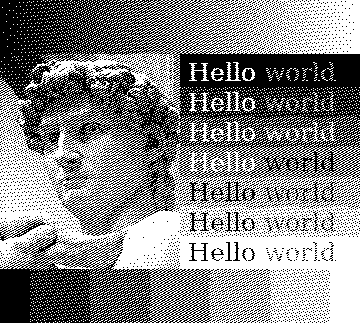
Definitely, I've been trying out a lot of dithering algorithms, and while they have big differences with only black and white as soon as you start adding more shades of grey they all look pretty much exactly the same as the input image. I'd imagine good dithering with colours would look amazing
Comment · 9 months ago
Just had a look at this and here is the result for the test image: https://uploads.peterme.net/test-image_qr.png.

Looks pretty good! It looks a bit like a dither, but with fewer artifacts. Definitely a "sharper" look than blue noise, but in places like the transitions between the text boxes you can definitely see a bit more artifacts (almost looks like the boxes have a staggered edge).

Thanks for bringing this to my attention!

Comment · 9 months ago
Thanks! I would imagine printing on paper would be a completely different ball game. I actually considered scanning the actual epaper display to show each of the dithering techniques in their intended environment as it does change the look quite a bit. From the little I know about typography and things like ink-wells I can definitely see how certain algorithms can change quite significantly. The original post here has a pattern which looks similar to old newspapers, maybe that's worth looking into?
Comment · 9 months ago
Just did a bit of a deep dive into dithering myself, for my project of creating an epaper laptop. https://peterme.net/building-an-epaper-laptop-dithering.html it compares both error diffusion algorithms as well as Bayer, blue noise, and some more novel approaches. Just in case anyone wants to read a lot more about dithering!
Comment · 10 months ago
Same! I've already signed up for the Time 2 and super stoked for it, then I saw the announcement for the Round 2 and I was about to switch over until I noticed it didn't have a heart rate sensor. I know its sleek and elegant, but that slight bulk would be worth it in my opinion. And who knows, with the extra thickness they might've been able to squeeze in more battery to get it to the 30 days battery life cited for the Time 2.

Also unfortunate that it's missing the RGB backlight of the Time 2. I can think of a few good use cases for it, but if it's only on the Time 2 that means fewer apps would use it.
Comment · 10 months ago
I've been wanting a browser plugin like this for ages. Basically tell it which sites to limit, then once loaded it won't re-load for a certain amount of time, or until the next day (not necessarily 24 hours). This way there is no reason to keep checking the news, they won't change.
Comment · 10 months ago
Indeed, I have a remote doorbell where the outer button is a piezo button and the inside bell part is connected to a socket. But the button is quite thick, presumably because it needs a bit of travel to get enough energy. Granted that's for a device that sends multi-wall penetrating strength of 433Mhz radio waves. For something like this where the distance is only about 25cm you might be able to get a button small enough.

Live from the official Hacker News API

A modern reader for Hacker News · SvelteKit + Skeleton