

w7
Joined 9 years ago
Karma
242
Submissions
130
Member since
Feb 1
Joined 9 years ago
https://rsf.org/en/venezuela-censorship-exacerbates-earthqua...
As far as self-hosting goes, it looks like there are some FOSS projects now, eg https://containerssh.io/
Instead it seems to be populated with what seem to be Heroku API and git credentials.
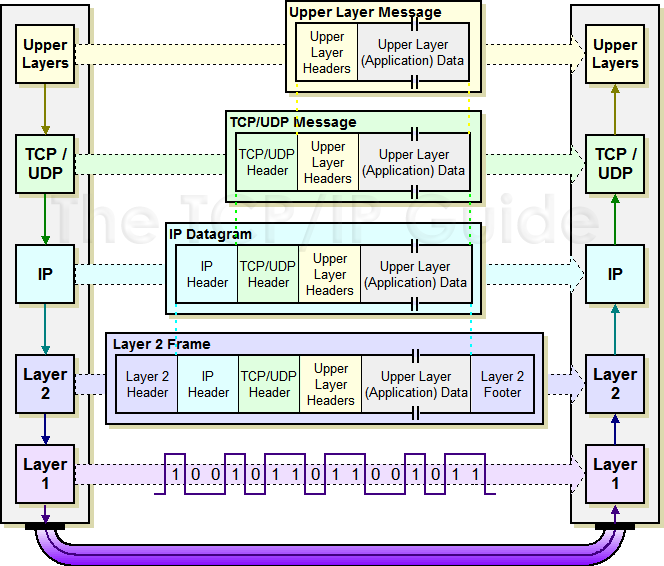
I don't know if it's missing in people's course work or what, but I've had to use http://www.tcpipguide.com/free/diagrams/ipencap.png many a times to explain how stuff like VPNs work, correct statements like "firewalls don't have a routing table, firewalling is layer 4", explain things like MTU and payload size, or why certain traffic doesn't go beyond a broadcast segment normally.
Personally I think this is one of the better visualizations.
Allied bombing of Japan in WWII destroyed upwards of 3.4 million homes and rendered the areas unlivable for a period of time.
You can see discussion on this going on as far back as 2015, explicitly in regards to what "SIGINT enabled" means and Cavium: https://www.metzdowd.com/pipermail/cryptography/2015-Decembe...
Am I missing something here? People are talking as if there is some new backdoor that's somehow avoided detection. Did everyone just miss this discussion in 2015?
Discussion of the "Sigint Enabling Project" goes as far back as 2013 on HN itself.
They're basically THE company for buying cheap, but functional, networking bits-and-bobs-- either in bulk, or as an alternative to prowling ebay for smaller purchases.
I use them all the time for transceivers, cables, DACs, etc.
Mussolini was in Milan, and stayed in Milan, when he ordered the coup march to Rome.
Mussolini lead his coup from >100-600km away from the march, why would the leader of Wagner need to be in the convoy?
I'm pretty sure every consumer router since at least 2002, if not further back, has had some stateful firewall implementation with default deny rules.
Much like a house is more than just the structure itself, so is the realm of computers.
Generally in Go: functions, structs, and consts are namespaced in a way I think is familiar to most, by package origin.
If something is not, then it's either a function/struct in the same namespace (same file, or directory), variable in same scope, or it's a built-in.
Built-ins like `append`, are not much different than say `map`, `filter`, `max`, etc in Python.
Anything sourced from a subdirectory, parent directory, or sibling directory needs to be explicitly imported via the module path.
Rather I think it'd be better phrased as "frameworks should use simple abstractions and methods as often as possible", which the language naturally pushes people towards imo. I believe this causes most Go frameworks to be referred to as "microframeworks".
Go: https://github.com/kyleconroy/sqlc
Rust: https://github.com/cornucopia-rs/cornucopia
This is my preferred method of interacting with databases now, if available.
Very flexible.
Following the event involves trying to see past the state's narrative and take in anything that trickles through. Combine this with the fact that it's likely far easier for most HN readers to send aid to, or know someone in, a friendly nation like Japan. You get the recipe for coverage of Venezuela being muted by comparison.
https://www.amnesty.org/en/latest/news/2026/06/venezuela-hum...