voqv
Joined 8 years ago
Karma
248
Submissions
88
Member since
Dec 7
Joined 8 years ago
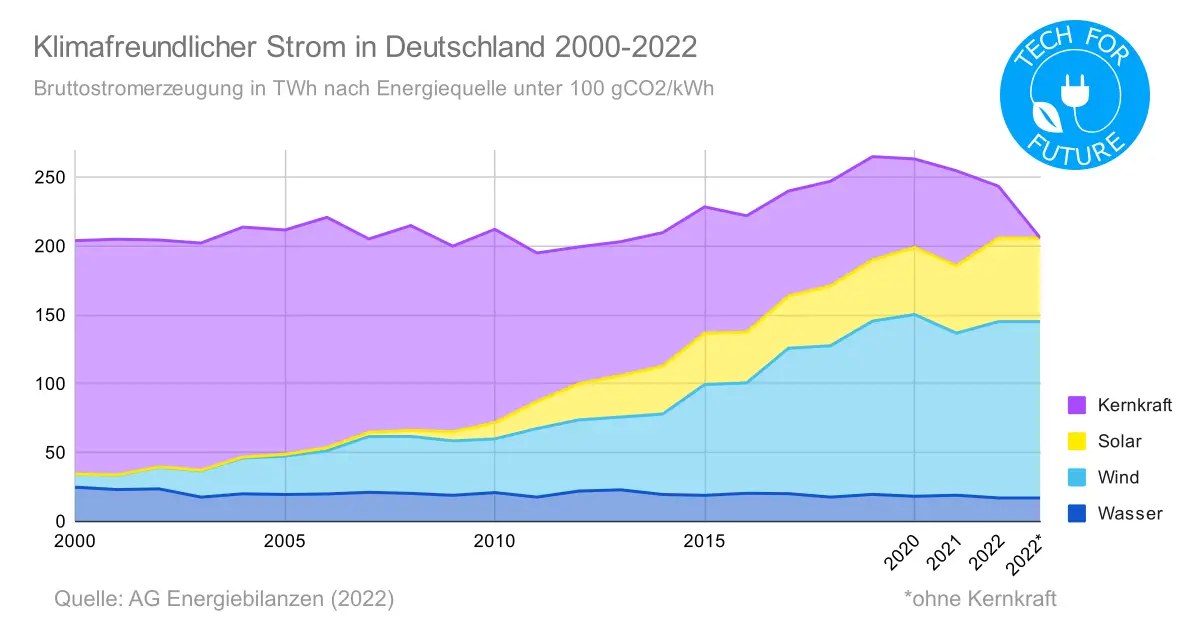
You can see here [1] that on a time frame of 2000 to 2022 Germany is yet to replace reduction of nuclear generation (Kernkraft) with renewables. Construction of renewables in 2023 has only accelerated 50% relative to 2022 [2].
[1] https://www.tech-for-future.de/wordpress/wp-content/uploads/... [2] https://www.energy-charts.info/charts/installed_power/chart....
Only if you omit cost of energy storage infrastructure and grid upgrades necessary for VRE.
> Secondly, it's not a responsive source of electricity - so you can't modulate the output easily.
Repeated often by nuclear critics even though there's evidence out there of German nuclear modulating load within 24 hours.
> Fourthly, as we found last year, during heat waves rivers can run dry causing a shortage of water to cool the plants forcing them to go offline.
French powerplants did not go offline last summer, a few of them that lack sufficient cooling tower infrastructure had to eject hotter than usual water into rivers.
> that plan is out of the window
There hasn't been officially confirmed, soon there will be a report called "Power plant strategy 2026" that will give a better outlook as to what is gonna happen this decade.
That's not sufficient for pumped storage at scale, but Germany is mostly focusing on hydrogen for now.
Economic challenges of quickly building grid-scale battery storage , battery production for the entire globe, NIMBY's etc.
> Modern batteries don't burst into flame
they literally do
> the overwhelming bulk of storage is not batteries
Well overwhelming bulk is a high bar and storage is geography dependent. Germany f.e. can't build as much pumped storage as Australia and Australia built a large amount of battery storage vs PSH.
For comparison, it seems Germany uses nearly 2x more electricity than Australia and currently has about 10x less pumped storage (including wip) than what Snowy 2.0 will have alone.