

shawndrost
Joined 19 years ago
Karma
2,296
Submissions
621
Member since
Jun 27
Joined 19 years ago
The most important driver of power system costs is "firm capacity"; a MW of four-hour battery might be 10%-50% as valuable as a MW of gas turbines given that the latter will run for 100-1000 hours per year when the batteries are empty and the prices are much higher. This is true on the grid or behind the meter.
The other place I'd push back on this article is its belief that America doesn't want to trim the grass in Iran every few years. We are pretty committed to Iran not having nukes and the American people seem to have liked this war and the earlier strike pretty well.
Some learning products are just content with zero container. Books are the limit example. Karpathy's "Let's build GPT" is another.
Most learning products -- and all apps -- live or die by the container they create. (There is no reason to build a learning app other than to build a container. If you feel you have the best content, ship it on a content platform and save yourself a very painful distribution slog.
Duolingo is in the container game. Their container is made of every cheap trick in the book -- notifications, streaks, etc -- because they work. My startup was Hack Reactor, the coding bootcamp, and we did it with pair programming and fixed classroom hours. (We had great content, but our competitors with good containers and bad content did leagues better than vice versa.)
If you're building an app, you're in the container game. You can build a great container with no cheap tricks. I have done so! But you can't build a great learning app with no container, and you can't build a great container if you if you don't want to change your users' patterns of engagement and attention.
So, what is your container? How will you weave a powerful spell that meaningfully transforms the attention and engagement of the app's user? What will cause them to pull up your app again and again, when they would have churned from a simple anki deck or whatnot? Given that you find it distasteful to use the easy levers you mentioned (notifications, "streak" psychology), what alternatives can shift your users' patterns of attention and engagement towards the learning task?
If you have great answers to those questions, great! If you don't want to build a container, build content on a platform with easy distribution. If you want to build a container but you don't want to shape your users' attention or engagement, you are confused.
Usually when people say "corporations aren't people" I think they are confused about the need for an abstraction. But you acknowledged the need for an abstraction.
I don't imagine you are confused about the status quo of the legal terminology? AFAIK, the current facts are: the legal term "person" encompasses "natural person" (ie the common meaning of "person") and "legal person" (ie the common usage of "corporation"). In legalese, owning shares of legal persons is not slavery; owning shares of natural persons is; owning shares of "people" is ambiguous.
I don't imagine you are advocating for a change in legal terminology. It seems like it would be an outrageously painful find-and-replace in the largest codebase ever? And for what upside? It's like some non-programmer advocating to abandon the use of the word "master" in git, but literally a billion times worse.
Are you are just gesturing at a broader political agenda about reducing corporate power? Or something else I am not picking up on?
The core thesis of the book (per Claude) is: "Traumatic experiences become encoded in the body's nervous system, muscles, and organs, not just in conscious memory."
The perfect exposition of the concept is downthread, in a comment by 'neom, which I will excerpt: "[The acupuncturist] moved the needle, [I did] more crying, deeper, deeper crying, he kept moving the needle till I thought all the needles would burst out of me from how deeply I wanted to cry but he told me not to be scared and I thought I was going to die. Anyway, he left me alone in that room for about 35 minutes while I wailed, I mean, awkwardly wailed. After everything started to calm inside me, I slowly started to be able to think again, and the thought that was there was the memory of the guy who sexually abused me when I was a kid, moving his hand off my hip." (Thank you for sharing, neom.)
I've had two similar experiences myself in the last year. I haven't read the book and don't know how this subject shows up in the scientific literature, but the proprioceptive experience leaves zero room for doubt about what is happening.
People say lots of dumb and wrong things about trauma. Maybe the book contains some of that, but its titular observation is fascinating, true, and maybe even useful!
I'll close with a related theory of mine, also derived through proprioception: one of the functions of the full-body sob is to reorganize muscular patterns which share an origin with (are identical to?) the emotional origin of the tears.
Lonesome Dove -- A great story about washed-up Texas Rangers with achingly beautiful writing.
The Last Picture Show -- More tonally similar to Cormac's stories. Coming of age in a dusty Texas town.
Leaving Cheyenne -- I have never in my life recommended a romance novel until this moment. I'm literally crying as I write this, remembering the closing scene.
Would you agree that "actual regulatory evasion" has been a top-three use case across the history of stablecoins? (That is: hackers, money launderers, sanctioned entities, and crypto exchanges do things with stablecoins expressly because doing them with dollars in banks would be illegal in an enforceable way.)
And, would you agree that GENIUS is a formalization of the low-regulation status quo of stablecoins? (That is: the bank system does KYC, AML, and reporting on both sides of every transaction; the stablecoin system generally only does that for onramps and offramps.)
This is not to say "regulatory arbitrage" is the only thing going on with stablecoins. Existing payment rails are imperfect and rent-seeking for reasons that don't have to do with the above. I'm just surprised you're describing the arb as such a non-issue.
Anyway, yeah, thanks for the exchange!
These quotes are ~compatible with your 4.4TWh number. If you still think the below DOE link is wrong and "...exceeds 2023 estimates for all data center usage globally" could you share why you believe that?
(Note that my "extremely wrong" is not directed at the literal text "LLM inference has a carbon impact of, like, a couple Google searches" but with the implication that LLMs have negligible carbon impact. If you think DCs were using 4.4% of US power in 2023 and growing at 20% YOY, and are a sizable-and-fast-growing carbon impact -- but that one LLM call is a small carbon impact -- I'll concede the latter and soften "extremely wrong" to "your original comment carried implications you didn't want".)
https://www.energy.gov/articles/doe-releases-new-report-eval...
The "financial system" is even more central a player when you consider the universe of potential crimes. Why don't drug dealers put their illegal and ill-begotten money in the bank? It's because the bank is obligated to ask a million questions, and occasionally, to freeze accounts. Why don't North Korean hackers request payment by bank transfer of USD? Because those payments can be put on hold or reversed by the financial system, which is a tool of the "police" in a way that Bitcoin never can be or will be.
The "financial system" is literally a technical system which has been effectively deputized by the "police", and as a matter of technical reality the "financial system" enforces the laws in ways that bitcoin (and exchanges, custodians, etc) are designed to prevent. Financial systems sometimes return stolen money and enforce laws with the involvement of literal police, but mostly not.
Some may not like the laws, and they can argue for why bitcoin is great. But if you like the laws, you should grapple with the fact that Bitcoin was designed to robustly foil the laws. On purpose! This property is called "permissionless" or "censorship-proof" by people that like it.
Load growth was flat 2005-2020, and now it's growing at circa 2%. Recent growth is almost all commercial and industrial, not residential [1]. There has been some manufacturing reshoring, etc, but the main driver is data centers [2].
"[D]ata centers consumed about 4.4% of total U.S. electricity in 2023 [and ~1.5% in 2014]." "[T]otal data center electricity usage climbed from 58 TWh in 2014 to 176 TWh in 2023 and estimates an increase between 325 to 580 TWh by 2028 [which would be circa 20% YOY growth]." [3]
Total US power use in 2023 was ~4000TWh. Compute power demand was at 4.4% of that and has been growing at ~20% YOY. (McKinsey forecasts 23% YOY growth and 2025 data center capex is growing 30%[4] but let's be conservative.) If 20% holds from 2023 through 2030 data center power demand will be at ~630TWh (16% of the size of the 2023 grid). If it holds through 2040 it will be at ~4000TWh (100% of the size of the 2023 grid). (No citations here, this paragraph is just analysis, and 630/4000 TWh are just 176*1.2^7/17. However these numbers are similar to the forecasts in [2] and [3].)
New data centers are more often powered by natural gas (and less by wind/solar) vs the grid at large, and will be true for the foreseeable future. I don't have a definitive citation for this but it's obvious to anyone close to this industry (as I am) and you can dig up any number of confirming citations about specific data center stories or utility IRPs (integrated resource plans). One concrete fact supporting this narrative is that gas turbines are sold out for the next ~6 years, which I don't believe has happened before in this century. Gas is on an absolute tear.
(Zero-carbon data centers that you read about, like Three Mile Island or next-gen geothermal, are specifically manufactured to disrupt the powered-by-gas narrative. They are about as common as data centers built in a way that revives coal plants; that is, they are a real but small phenomenon.)
So, that is the story. A) Power sector emissions were in decline, because of flat load growth and the replacement of coal with wind, solar, and natgas. B) This isn't true anymore; the grid is expanding quickly again, AI is the main culprit. C) At least for now, load growth is happening in a way that is dirtier than today's grid. C) If you believe that AI is going to continue to grow for 5-15 years like it is now, you also think that AI is (and especially, will be) a major driver of US greenhouse gas emissions.
And to add an anecdotal rebuttal to your earlier comment: sure, inference is just a few google searches worth of power. But now google searches have inference, so they are a few more times more power-hungry than they used to be. And when I code, I use way more inference than the number of times I used to google. And remember that when we say "inference", we are talking about last-gen LLMs; reasoning models (which are, as of a few months ago, the default in chatbots) are a chain of inferences which can be arbitrarily long. The current status quo is much more worrisome than your quip, and the problem compounds quickly if you extrapolate at all.
We have discovered a new and outrageously popular way to use compute, we built $455B worth of power-hungry data centers last year [4], and it is having (and will have) a huge effect on greenhouse gas emissions.
[1] https://www.eia.gov/todayinenergy/detail.php?id=65264 [2] https://www.utilitydive.com/news/load-growth-challenges-supp... [3] https://www.energy.gov/articles/doe-releases-new-report-eval... [4] https://www.ciodive.com/news/data-center-ai-cloud-infrastruc...
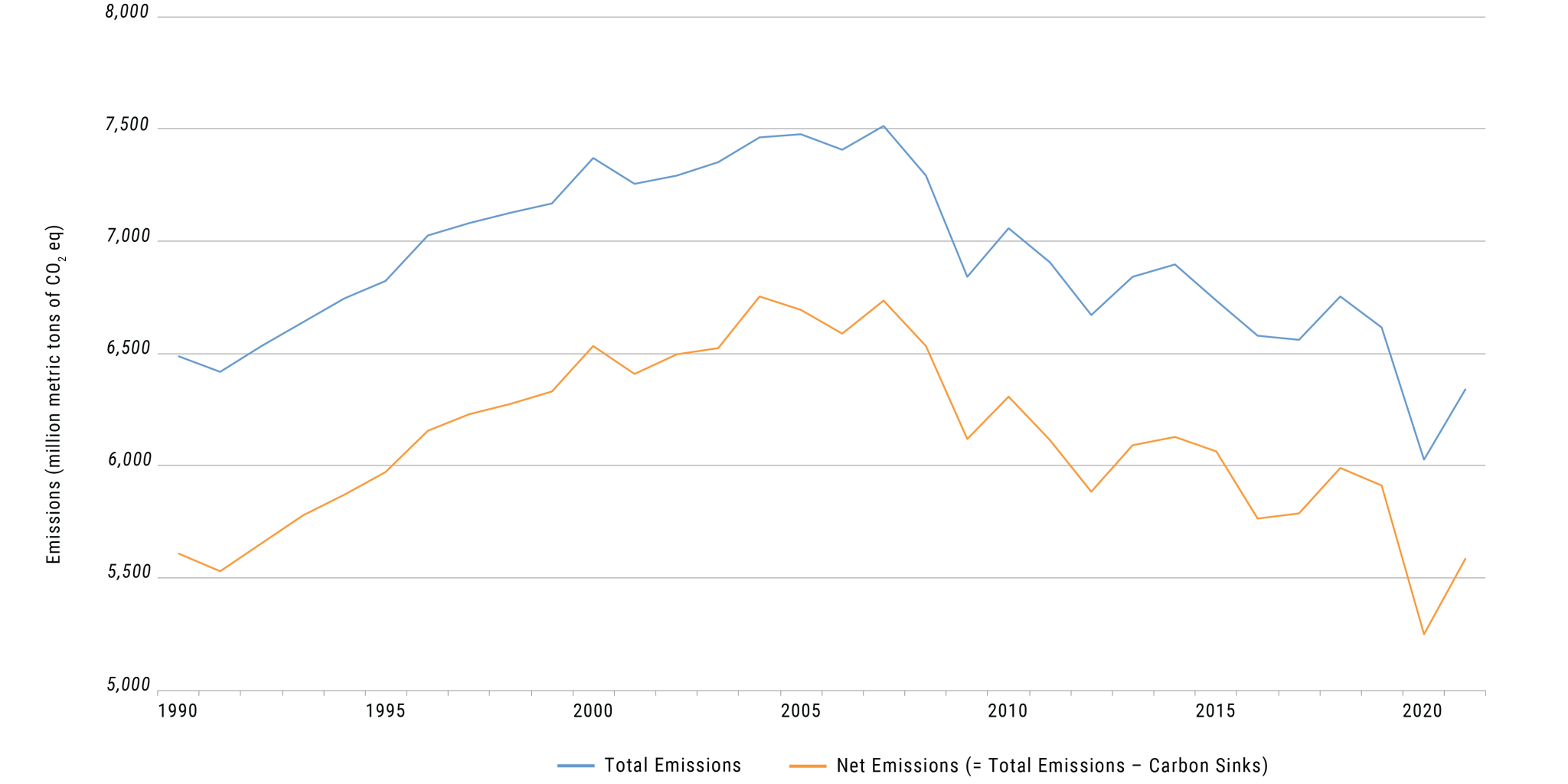
The story of US power sector emissions was a good story. Emissions appeared to be in secular decline from 2005 through 2022, through the crypto nonsense, and the ramp-up of EVs. In large part, this was due to stable power growth, the replacement of coal with natgas, and the adoption of wind and solar. We were on track to go to 0-10% of historical emissions by 2040. https://www.c2es.org/wp-content/uploads/2022/11/2024-GHG-Tre...
LLMs changed that story; it is now a bad story. Emissions are back on the increase. Natural gas power plants are sold out for six years plus. We are on track to go back to 100% of historical emissions by 2040. EVs are a factor but were a factor in 2018-2022 as well. In terms of popular narratives, it's pretty accurate to say that LLMs singlehandedly reversed the only reason for climate optimism in the US.

Formerly: Cofounder of Hack Reactor, the coding bootcamp.
[email protected]