

qazwsxedchac
Joined 10 years ago
Karma
187
Submissions
27
Member since
May 30
Joined 10 years ago
The positive "flywheel effect" where transport connectivity enables network effects does exist, but it does not follow that free public transport leads to negative effects.
Still, at this level, brittle infrastructure is a political risk. The internet's famous "routing around damage" isn't quite working here. Should make for an interesting post mortem.
Longer answer: In the UK, Apple already implements age "verification" at the OS level, starting with IOS/IPadOS 26.4. If Apple had not implemented this, it would still be in compliance with UK law. Apple is anticipatorily obedient.
A company like Apple has visibility of the legislative pipeline in its markets. Looks like the UK was a test bed.
Lots of OECD countries, all at the same time, are pushing for online age verification or OS-level age verification, both equally intrusive and implemented in privacy-violating ways by conflating identity verification and age verification.
The end result is not protecttion of minors, but abolishing anonymity on the Internet. Social media companies claim to want the former, but in reality just want to shift liability to OS and device vendors. Governments happily accept the "side effect" of being able to find and root out dissidents.
The Online Safety Act does not require device manufacturers to enforce age "verification" at the OS level. If Apple had not implemented this, it would still be in compliance with UK law. Apple is displaying anticipatory obedience here, which is the opposite of good citizenship.
Two things stand out from this fiasco:
1. Apple, and those who praise them for what they just did, don't appear to have learnt from history. Anticipatory obedience used to be known as "vorauseilender Gehorsam" during a particularly dark period in the history of a country a few hundred miles southeast of the UK. It was one of the factors enabling the darkness.
2. The UK is a small enough market for Apple to treat it as a test bed. Which it probably is in this case, and which means that removal of anonymity aka "OS-level age verification" is coming to a lot more devices in a lot more countries soon. See also the uncanny coincidence of lots of OECD countries pushing for online age verification at the same time.
(Source: First hand experience.)
The UK's proposal makes the "digital ID" a pointer to an entry in a centralized database. This database is the definitive record of what you are allowed to do or not do (like reside and work). Which can be changed or deleted at the stroke of a key, through human error or malice. Then what?
When (not if) the database becomes an attribute store across a wider scope, the implications are scary. The "digital ID" as set out today can't work for its ostensible purpose. Therefore its actual purpose isn't being declared. Not hard to connect the dots.
The attractor shown in figure 1e has such periodic components, and identifying these does help, but only with very near term forecasting. When the accumulated forecast error crosses a threshold, it suddenly causes a large phase error, best seen from about point 75 onwards in the x and y components. From that point onwards the forecast is useless.
AIUI, they use the 3x3 neighbourhoods to capture local directional and curvature (i.e. gradient) information in the distance matrix. They then apply two heuristics (reduction to an 8-bit binary number and binning into sextiles) to reduce the floating point gradient information to coarse integers to aid pattern recognition.
The more recent paper adds another heuristic (empirically chosen similarity threshold) to aid finding starting points of recurring patterns.
[0] https://doi.org/10.1038/s41531-021-00240-4 , Equation (5) onwards.
One thing I don't understand is the addition of the constant 3 to the row index (in the paper just after formula 6). Intuitively this should be only 2, because the last row vector of the local topology lags the last state captured in the distance matrix by one row, and then we want to move ahead one more row to start forecasting.
What am I missing?
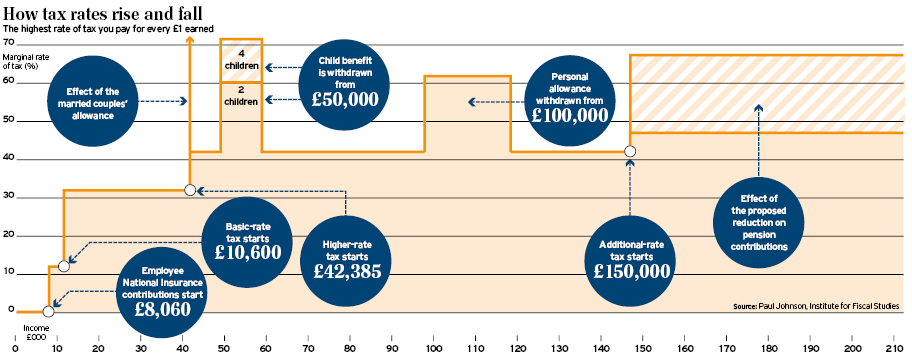
True, but they are harsh discontinuities, sufficiently so to have the effects I described. And yes, there is a common combination of personal circumstances (high income plus student loan repayments plus child care subsidies) which means that any gross salary between £100K and £117K means less net income than being on £99,999 gross. I've not been able find a graph for that, but the maths checks out.
The result of this particular combination is to effectively impose a ceiling on many employees at £100K gross, because they would have to receive a greater than 17% pay rise to be better off than before.
- doctors going part-time to keep their income below £100K, in the middle of a shortage of doctors across the health system
- employees turning down promotions because with the combined effects of income tax, student loan repayments and loss of childcare subsidy the effective marginal rate of income tax between £100K and £117K is > 100% (!)
- single high earners (core voters of the present government) effectively subsidising families of middling earners (the opposition's core voters) because the discontinuities apply to single person's income, not combined household income
The behaviour changes are simple first order effects. The second order effects on public service workforce availability and overall tax take were also highly predictable.
[0] https://www.telegraph.co.uk/multimedia/archive/03270/tax_327...
https://www.mahngerichte.de/mahngerichte/wedding/
not at any other municipality's court.
Only do this yourself if you speak and read German well enough to handle the correspondence yourself. Otherwise you really need a German lawyer to act for you.
It is sometimes possible to agree payment of lawyer's fees according to the value in dispute instead of being billed for time spent. This can keep costs down.
Adults will understand that the "shush" gesture with the soldering iron is supposed to be a play on the "secret" in the title, but a large part of the target audience is 12-15 years old. There will inevitably be some who'll imitate the picture, with painful results.