powersnail
Joined 7 years ago
Karma
2,781
Submissions
794
Member since
Feb 21
Just a naive coder, grappling through the world. https://powersnail.com
View on Hacker NewsJoined 7 years ago
It's hard to imagine what Headspace would like to achieve if this were an exploit executed by them. It's so salient, that it makes no sense to do on purpose. At least some portion of Apple employees and their families are going to be affected by this, and this would escalate to the legal department immediately.
My money is on Apple being the buggy one here.
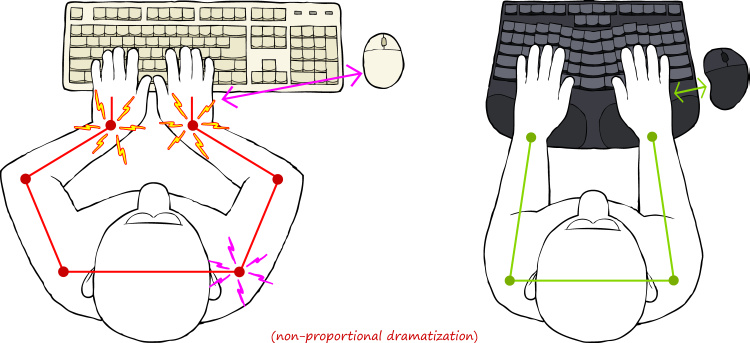
https://www.justinmklam.com/posts/2026/02/beginners-guide-sp...
I don't know if it's just me, but I don't use the keyboard like that. I know the illustration is said to be exaggerated, but still. There is no need to squeeze your hands in front of the keyboard. Just naturally bring your hands in front of chest, the same as when you are reading a book or writing notes with a pen. No twisted wrists. No ulnar deviation. The idea that you can't do something with your hand in front of the center of your chest without hurting the wrists seem like a strange supposition.
Admittedly, I've never looked at a significant number of people typing on a non-split keyboard, so I don't have the data to refute the need of this invention. I just feel like the natural posture already doesn't have the problem of ulnar deviation.
What's particularly interesting, is that the replicas really do look like the actual food. Some replicas are so good, that I would not be able to tell that it is fake even by close inspection. One of the gyoza replica got the doughy body, the crispy bottom, and oily surface that is visually indistinguishable from a real one. Even the touch is somewhat real.
I'm not saying seeing those replicas gives me a better appetite; that's doubtful. I just appreciate the crafts.
The other side of the coin is that the actual food do look like the replica/photos, so it's not a bait-and-switch scheme. The people who prepare the dishes---be it a chef or a worker at a fast food chain---all seem quite accurate. Not that all dishes always look beautiful; but they do look consistent. Your plate of curry over rice might be plain, but it will look exactly the same as the previous order (and also as the photo), even if it is created entirely by hand. It's kinda amazing in its own right.
> Meanwhile, in restaurants without visual clues, you can only let your imagination go wild and guess what you're going to have. Once the plate is put in front of you, two surprises awaits you: does it looks like what you imagined and is it good? > > At least that's the experience I'm looking for in restaurants.
Well, you still retain the second part of the surprise: "is it good?". But yeah, it will ruin the first one, because of the accuracy. It's not something that particularly bothers me, but I can understand why you want to avoid the spoilers.
And furthermore, if you want fast code writing, you write in the language you already know. For some people, that is Rust.
I forgot what desktop application it was, but there was a time that I repeatedly needed to copy texts from a dialog, which didn't support text selection. It frustrated me so much, that I put together a script to do OCR on the dialog.
Supporting complex data types for copy & paste is good; but it is almost trivial to also support plain text copying as a fallback when it already supports copying of other mimetypes. The problem is that some UI has no support of copying in any format at all.
It's the peril of being a niche customer. I can and have voted with my wallet, but it doesn't nudge the needle anyway.
So yeah, I'd gladly pay a bit more to order via an app. When I'm ordering delivery, I'm already paying premium on that day anyway, the margin of which is way higher than 20%, so I might as well go all the way and avoid dealing with something I don't like.
If I'm not using an app, I'd rather run a mile to make the order in person, than make a phone call.
Yes, that's exactly what I mean. My girl friend has long hair, and doesn't wash with shampoo every day (which is somewhat common for long-haired people I believe), and the texture after shower is very different.
In college, especially exam week, we had more anecdata. It was possible to see people who 1) had not washed their hair, 2) had washed their hair in a sink with water only, 3) dry-washed with those sprays, and 4) washed with shampoo. It was very easy to tell which they did.
In general, soapy cleaner (or similar substances) is going to help immensely when cleaning oily stuff. And hair can be really oily. Water-only is just not the same.
One scenario I don't have is comparing other soapy products to shampoo. But shampoo aren't more expensive than other soaps anyway, so I never bothered to look.
I don't know the scope of "nothing" in your statement, but shampoo does help remove dirt and oil, in a way that washing with water only cannot achieve, which is the number one goal of using shampoo for most people.
This is verifiable by observing and touching hair of other people's hair before and after shower, which eliminates the possibility of shampoo manufacturers secretly altering what you perceive with your fingers.
Really can't see how this can be regarded as a recent idea.