mayukhdeb
Joined 1 year ago
Karma
142
Submissions
17
Member since
Jan 31
https://mayukhdeb.github.io
View on Hacker NewsJoined 1 year ago
Yep. Because of the structure, we did not have to compute the output of each weight column and simply copied the outputs of nearby weight columns whose outputs were computed.
Indeed. The problem with most AI research today is they simply do trial and error with large amounts of compute. No room for taking inspiration from nature, which is requires more thought and less FLOPS.
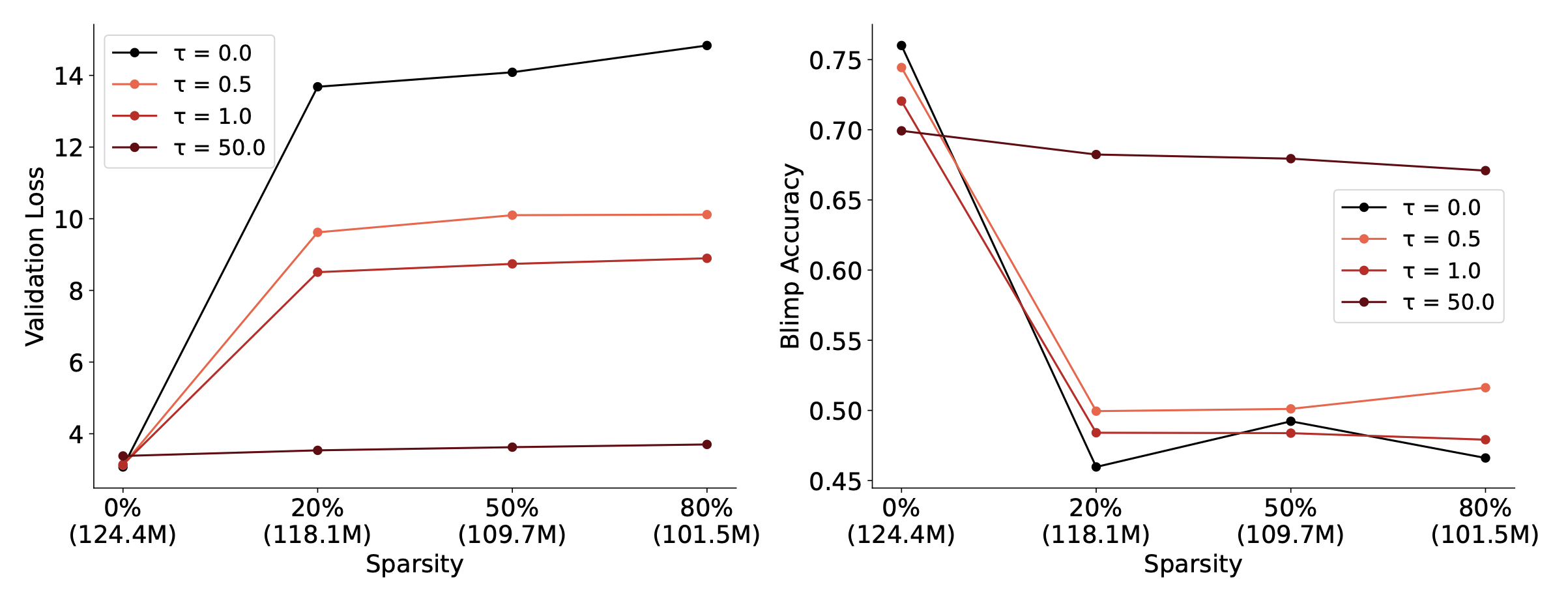
The explanation for the original title is this plot from our publication in ICLR 2025: https://toponets.github.io/webpage_assets/FigureEfficiencyNa...
You can find more details on the website: https://toponets.github.io (see section: "Toponets deliver sparse, parameter-efficient language models")
We find out that inducing topographic structure in the weights of GPTs made them compressible (during inference) without losing out on performance.
I encourage you to revert the name if you find it justified after looking into the evidence I've shown here. Thanks.
> it’s not scientifically useful
Having structured weights in GPTs enables us to localize and control various concepts and study stuff like polysemanticity, superposition, etc. Other scientific directions include sparse inference (already proven to work) and better model editing. Turns out, topographic structure also helps these models better predict neural data, which is yet another direction we're exploring in computational neuroscience.
This is true. The features closer together now have much stronger semantic overlap. You can watch how the weights self-organize in a GPT here: https://toponets.github.io/webpage_assets/banner_video.mp4
We're already studying the effects of topographic structure on polysemanticity.
More work is being done on this as we speak.
The gains in parameter efficiency was a surprise even to us when we first tried it out.
Other benefits:
1. Significantly lower dimensionality of internal representations 2. More interpretable (see: https://toponets.github.io)
> 7B model down to 6B
We remove ~80% of the parameters in topographic layers and retain the same performance in the model. The drop in parameter count is not significant because we did not experiment with applying TopoLoss in all of the layers of the model (did not align with the goal of the paper)
We are currently performing those strong sparsity experiments internally, and the results look very promising!