

Recent submissions

Comment · 5 years ago
Everything above. Friends don't let friends use App Engine, and by extension, fringe GCloud services they could break or shitcan at literally any moment

The technology of a vendor is way less important than its culture. So far Gcloud seems to understand that. Maybe the App Engine team is outside that org

Comment · 6 years ago
Hrm fair point. I'm not sure DNT could have been repurposed to imply consent under much newer regulations, but you're generally right, this mechanism predated the EU regs and somehow was passed up.
Comment · 6 years ago
If any browser vendor just pushed a trivial standard like

    X-Consent: no-cookies

    X-Consent: cookies-ok
Sites would have gobbled that header up overnight, and the other browsers would have received substantial pressure to follow.

But it's a missed beat by now, nobody is paying to have hundreds of thousands of web sites updated for such a thing even if it did exist.

Sucks none of the major browser vendors are based in Europe or this might have happened. Meanwhile, I'm no lawyer, it's not clear whether the header would pass the legal test, but I'm sure a sufficiently motivated party might have a good shot at arguing that it did

Comment · 6 years ago
I do not miss Google's monorepo one iota. It had huge benefits, but after stepping back far enough the result also easily begins to look a little like Stockholm syndrome. Anything they want to open source they basically have to rewrite from scratch because of that godawful repo, never mind reasoning about what actually ended up in your binary on any particular day when depending on such a gargantuan tree, and of course not to mention what by now is likely 10s of FTEs dedicated simply to managing the tree.

Those millions of LOC mostly only existed to serve their own purpose, and possibly the intrigue of many a doe-eyed eng. If I came across a codebase like that today, I'd likely be quite vocal on reallocating the evidently outsized engineering budget to some more productive use

Comment · 6 years ago
Coming from the outside world and looking (back) in, I simply can't ever imagine being in the kind of environment where discussing the choice of web framework or tool language would last more than 10 minutes, before whoever spoke last basically wins. But then, I'm the kind of techie who has lost their love of and has actively grown to despise tech.

"Is it supported?" "Yep"

"Can we hire for it cheaply? "More or less"

"Does it support the weird InternalSuperWidget it must talk to?" "Essentially"

"Ship it!"

Comment · 6 years ago
What happened to the Closure Compiler stack? It was infinitely ahead of its time, how the heck did they end up settling on Angular of all things
Comment · 6 years ago
Yikes, didn't realize they had the indecency to drink their own kool-aid. Angular, really? No wonder! Come to think of it, it's maybe been around a year since I last saw one of those tell-tale "page finishes loading to a blank page for 20 seconds before finally rendering" Angular sites
Comment · 6 years ago
This is "fixed" in DoH the same way it's "fixed" for encrypted SNI: by having a small number of superproviders servicing millions of domains.

With current encrypted SNI proposal, your privacy (between you and the superprovider) is /improved/ by talking to a site behind a large aggregating provider. It sucks (since the superprovider still sees everything), but that's how it is.

edit: added clarifications in (parens)

Comment · 6 years ago
Very good point! Sorry, I was confusing myself thinking about classic DNS.
Comment · 6 years ago
Tor is not a run of the mill SOCKS proxy, not least in that it inserts arbitrarily high latency into the user data path. On the other hand, an actual run of the mill SOCKS proxy would have visibility of the user's queries and their identity, defeating the purpose of the design.
Comment · 6 years ago
DNSCrypt needs meaningful industry support otherwise it's sadly irrelevant. I think by now we can all agree "industry support" basically means the 3 browser vendors. DoH has at least Mozilla and Google on board, and presumably Microsoft are tailing along.
Comment · 6 years ago
The user's IP address is masqueraded by the proxy, and neither the DNS mothership (Cloudflare) nor the ISP get to see both who the user is and what they requested. It's an extremely desirable property DoH currently lacks
Comment · 6 years ago
Opened this post expecting to be hating on another power grab dressed up as protocol engineering, but this one seems to actively /reduce/ the centralization of user data collection in DoH. Props to Cloudflare, I'm impressed.
Comment · 6 years ago
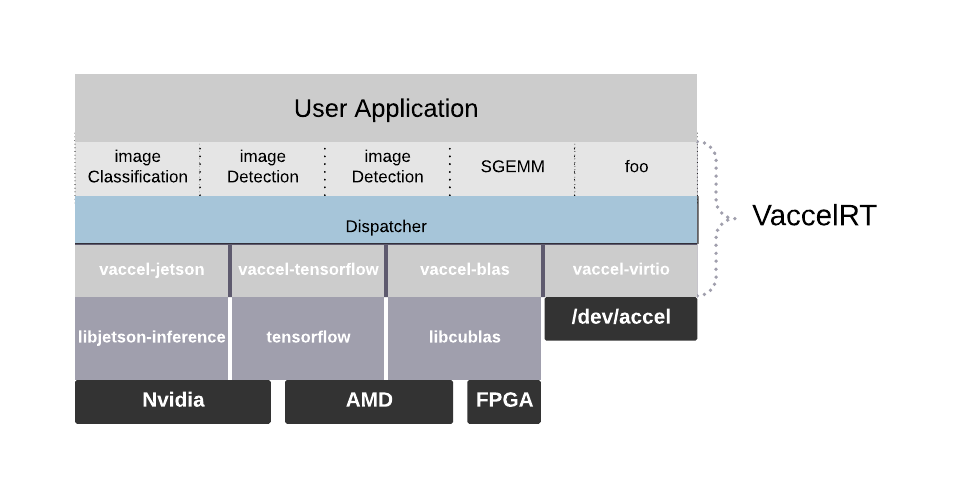
The block diagram here: https://blog.cloudkernels.net/static/vaccel_v2/vaccelrt.png#... should probably have some close variant on your home page, I've been around for 20 years and couldn't tell /at all/ what vAccel is.

My best guess was something to do with making VMs run faster
Live from the official Hacker News API

A modern reader for Hacker News · SvelteKit + Skeleton