kurlberg
Joined 14 years ago
Karma
236
Submissions
71
Member since
Sep 23
Joined 14 years ago
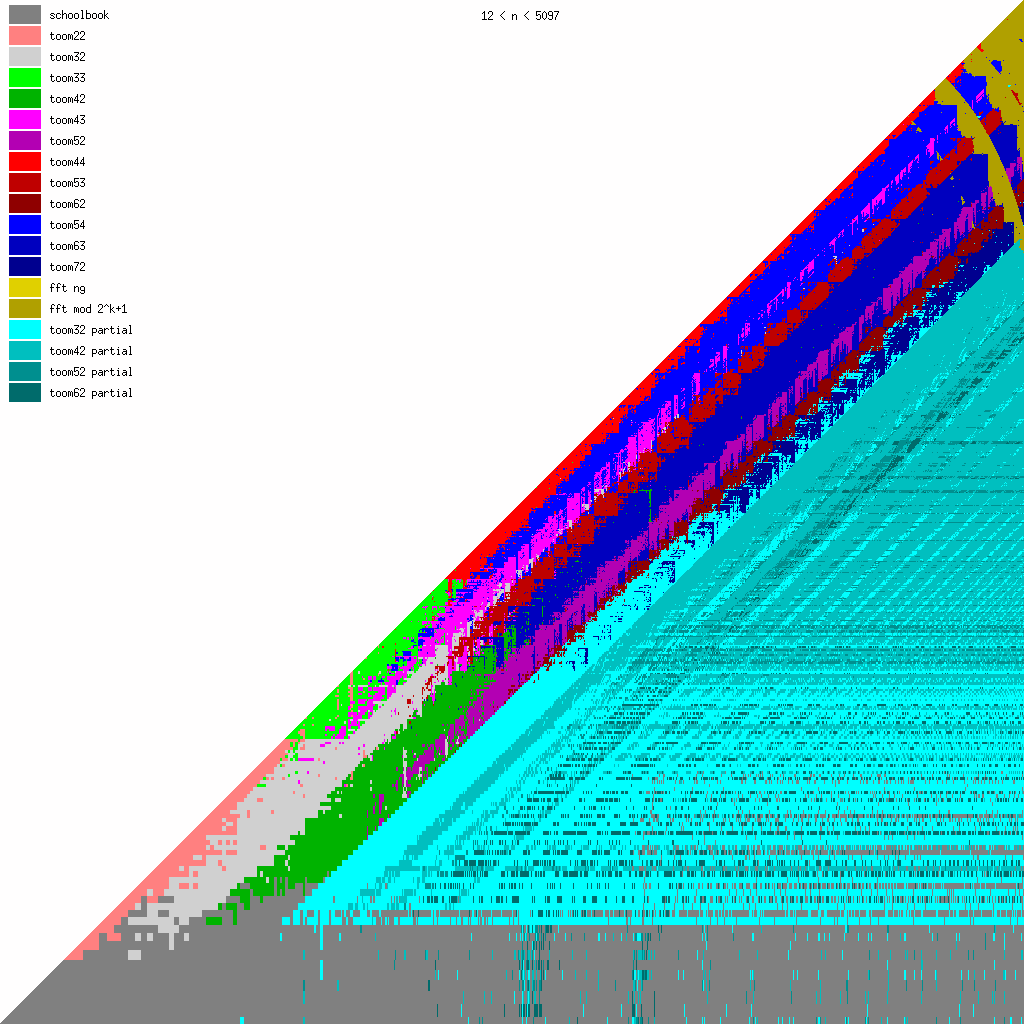
There is a nice picture of the "best" choice for different ranges of sizes of numbers to be multiplied at http://gmplib.org/devel/log.i7.1024.png
More context and explanation can be found at: http://gmplib.org/devel/
Learning Styles: VAK Doesn't Exist (Here's What Research Actually Shows)
https://www.structural-learning.com/post/learning-styles-myt...
Belief in Learning Styles Myth May Be Detrimental (by American Psychological Association)
https://www.apa.org/news/press/releases/2019/05/learning-sty...
More details at
https://terrytao.wordpress.com/2018/12/29/jean-bourgain/
(In particular, see the "???" in the Tao's annotated copy of Bourgain's paper.)
Math exposition is tricky: too few details and you're just floating in the sky, too many details and the audience loses sight of the forest for all the trees. You can go (more or less) all formal, but it's a pain for the writer and a pain for the experienced reader.
If it's any consolation, the punchline to the joke is that it often is small/big lie: the other mathematicians reads "Y" and goes WTF!? And then 1 minute, 1 hour, 1 day, or one week later says "aaah, that's what he/she meant! I guess it was 'obvious' all along". :-)
By Erdos-Kac, almost all integers of size about n^2 have about log(log(n^2)) ~ log(log(n)) prime factors. However, almost all integers in the multiplication table have about 2*log(log(n)) prime factors.
Kevin Ford gets much more precise asymptotic estimates.
https://www.theregister.com/2026/05/01/canonical_confirms_ub...
"Canonical says its web infrastructure is under attack after a pro-Iran hacktivist group instructed its members to target the open source giant."
Perhaps more to do with extortion rather than activism. (I have no idea how accurate theregister is on this story.)
Also, convolving a distribution with itself is NOT a linear operation, hence cannot be described by a matrix multiplication with a fixed matrix.
"Infinity is farther away than you thought."