

john_b
Joined 15 years ago
Karma
1,752
Submissions
498
Member since
Jul 6
Joined 15 years ago
What we should copy from Vienna is mixed use development. A huge portion of American suburbs are zoned as single family only and you end up with a housing shortage, horrible traffic, and pollution. Mixed use development allows density to increase while reducing traffic and encouraging people to be more fit (by walking or biking more). It's such a no-brainer from a whole-system perspective.
The problem is that NIMBYs and existing regulations exist to preserve the status quo and protect the equity long-term homeowners have accumulated. In places like CA there are additional disincentives to reform like Proposition 13 that favor long term owners at the expense of new homebuyers. Obviously a tax-advantaged asset is going to have a higher price than an equivalent non-tax-advantaged asset. And significant property tax revenue that could otherwise fund public transit and additional construction isn't collected as a result.
Eventually enough boomers will die and the demographic forces will shift and create the opportunity for reform, but this will be too little too late for a whole generation. I'd love for a concerted national effort to tackle this problem and reduce barriers to building the kind of housing America needs, but it's hard to see that happening anytime soon.
Aswath Damodaran has written a lot more on this topic. https://aswathdamodaran.blogspot.com/2017/10/the-bitcoin-boo...
He does agree with you in that Bitcoin will be judged as a currency, so its strengths and deficiencies as a currency will determine its fate.
While you might have done that kind of research, the article implies (correctly, in my view) that the typical Robinhood user did not. No surprise; that sort of research is time consuming and requires significant familiarity with the industry. Yet airlines, cruise companies, and other risky assets were preferred by Robinhood users throughout the pandemic.
[1] https://en.wikipedia.org/wiki/List_of_airline_bankruptcies_i.... These lists omit airlines that get bought up for pennies on the dollar by competitors.
I've never really understood the appeal of account-based password managers. It was a startup and it needed a business model, sure, so from the company's perspective it makes sense. But from a customer's perspective you're accepting a new type of risk that you don't have to worry about if you use a glorified encrypted list (e.g. KeePass) to manage passwords. The payoff is convenience, but personally no amount of convenience is enough to make me comfortable with storing all of my encrypted passwords on a single server somewhere and hoping that there are no exploitable security vulnerabilities (or malicious insiders who might seek to profit from finding or introducing them). Having an offline password manager that never uploads data to a server provides defense in depth, though it's less convenient.
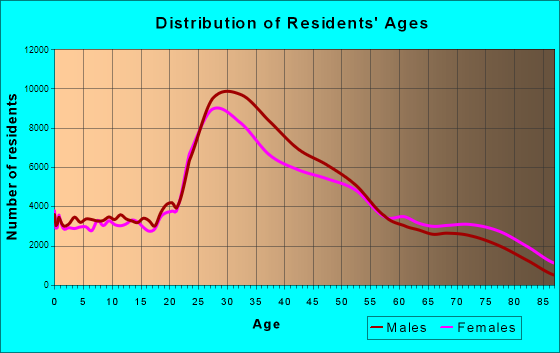
http://pics.city-data.com/agegraph/2455.png
(This is for residents of SF only, so it won't account for any differences that might arise due to commuters who live outside SF)
Edit, source page: http://www.city-data.com/housing/houses-San-Francisco-Califo...
Everyone who knows me knows that I do this and I have told them that I am not going to change. For emergencies, they know the people I usually see each day and know to call one of them.
I've discovered that when people can't expect to contact you on a whim at any time, they think ahead and let you know what their plans are in advance. Both parties can then arrange their availability in advance and use their time more efficiently.
After a year of doing this it makes you realize just how absurd and artificial the expectation of continuous availability is. My attention is a resource and I am going to control how I allocate it, not others.
Yes, but how do the EU regulations in question promote this goal? Background checks still exist, as does the information about you online. These regulations only impose a small burden to finding the information (by eliminating the quickest and most convenient way of finding it). They offer the illusion of control and nothing more.
> "My current opinion (which is not yet fully formed) is that it is wrong to order Google to unlist results; but, on the other hand, it should be completely legal to order Google to remove what is essentially a dossier that they have on a particular user (at that user's request)."
Again, you're confusing things that are related but not the same. The information cannot be deleted. If Google learned something about you from public sources, that information is in the public domain and Google doesn't own or control it (though it may offer access to it). If it gained that information because you used one or more Google services, then Google has a right to use the information for purposes specified in the EULA.
If you want to have control over your information then the only way to accomplish that is to not give it away in the first place. Neither the individual in question nor Google have any ownership over information once it's public. The only question is how easy and convenient accessing that information should be.
It only benefits those who are already powerful to make access to information difficult. For example, a company can still find out if you were charged with a crime even if Google doesn't return results related to that event, but you will have a much harder time finding out if that company pollutes the environment (do you want to dig through EPA files or review past court cases against the company?) if news articles relevant to that topic have been expunged from search engines.
"The Right to be Forgotten" is just doublespeak for censorship. Selling it as an indispensable tool for personal privacy is a sickening irony.
> "As the President said in announcing recent intelligence reforms, "We have to make some important decisions about how to protect ourselves"
> "Mr. Snowden's dangerous decision to steal and disclose classified information had severe consequences for the security of our country and the people who work day in and day out to protect it."
> "We live in a dangerous world. We continue to face grave security threats like terrorism, cyber-attacks, and nuclear proliferation that our intelligence community must have all the lawful tools it needs to address."
There is nothing new here. From a different age, we had this observation from another power hungry man:
"The people don't want war, but they can always be brought to the bidding of the leaders. This is easy. All you have to do is tell them they are being attacked, and denounce the pacifists for lack of patriotism and for exposing the country to danger. It works the same in every country."
-Hermann Göring
The U.S. constitution contains some strong protections against this road to fascism, but many have been eroded or subverted over time. Our government's design is intentionally inefficient, its members supposed to change regularly, and our court system is insular and slow for a reason. But these protections were created prior to the era of mass media, and now fear can be used as an even more powerful tool for control than when the country was founded.
I suspect that in the long term, even stronger hedges against totalitarianism will be needed. Democratic republics work well when the voting public is informed, patient, and aware of history. If you can whip them into a fervor with fear mongering, make them forget the past, and make quick emotional decisions, then instead of a nation of citizens you have a troop of apes--far easier to control.
The gist is that people who are willing to pay a subscription to disable ads are exactly the people that advertisers would like to target. When a service assembles a list of such people, the value of that list to the advertiser generally exceeds the sum of the individual payments provided by the subscribers.
You can increase the subscription fee, but then you'll have less subscribers and the ones who are left will be the most valuable to advertisers (i.e. they have the most disposable income). If you decrease the subscription fee, you will have more subscribers but not a lot more, because the primary obstacle for online subscription type services for most people is not the price but the idea of paying for something they are accustomed to getting for free.
So if you get 1000 people to pay $1.00 per month for your niche Swedish grunge music streaming service and double the price, a decent number of them will not like that and some of them will unsubscribe. But if you halve the price to $0.50 per month you won't see many new customers since many people aren't willing to pay even small amounts for music streaming. Advertisers, meanwhile, don't have these mental obstacles and just try to price things as objectively as possible. And they see a narrowly targeted list of people with a highly correlated list of interests and purchasing tendencies and value it appropriately.
This might explain why services like Hulu have gradually introduced more advertising into their paid subscription services. As long as two groups of people are are paying them (customers and advertisers) one will generally be willing to pay more. Economic forces on the internet seem to result in advertisers having more purchasing power here.
The human need to assign blame to a single source is an evolutionary remnant that we should be aware of and try to correct for, rather than embracing it. Just because something is terrible doesn't mean you can put all the blame for it on one person or group of people.
You're right that public housing doesn't fundamentally require income restrictions. The government could forbid all private construction and take over home development itself, placing price caps as needed. But if you think something like that's going to work in the US when we can't even accomplish much more minor housing reform, you're dreaming. Vienna's model is certainly not that radical.
For starters, even Vienna's social housing model has income restrictions. If you and your partner both earn the average 2023 Viennese salary (about €52,000/person) then you don't quality for social housing because your combined income significantly exceeds the annual threshold (€79,490 for two people in 2023).
Even if you do qualify, you are only eligible if you have lived in Vienna for two years already. This system does nothing for new transplants. And once you do qualify, the wait time to be approved for an apartment can be in excess of 5 years. They even have a "bonus period" to move people who have been waiting for more than 5 years up in the line, because the city recognizes how frustrating that must be.
The system is easily gamed too. Vienna only checks your income once as part of the process. If your income increases later on (e.g. because you finished school and got a great job) you don't become ineligible. That part is fine by itself, but you can also transfer the apartment to a qualifying family member if you decide to move out, and they don't need to wait 5 years. This contributes to the reduced supply and long wait times because it reduces inventory and rewards those with family connections in the city.
And of course this whole system is far from free. If you make the average Viennese salary your income tax rate is 42%, whereas it's 25% for the average American worker. The average Vienna home is worth around 1 million euros and the property tax rate on such a home is a whopping 3.5%. Even in expensive coastal places like San Francisco and San Diego, property tax rates are barely above 1%. The tax burden to fund this kind of social housing (and other great things too, to be fair) is definitely heavy. It's fine to point out the positives of such a system, but the costs have to be acknowledged as well. And in the US I don't think the taxpaying population of any city is willing to bear those kinds of costs.
Vienna's system does do a great job mixing different people together, as you note. But not all of this is due to public housing. Quite a bit of it is simply how walkable the city is and how great their public transport options are. Even a moderate amount of public housing for low income individuals scattered throughout a very foot-friendly city would do a great job mixing people together.