

hfo
Joined 8 years ago
Karma
35
Submissions
12
Member since
Apr 19
Joined 8 years ago
The reason for the edema is not given, perhaps cardiac insufficience, perhaps she didn’t take her pills (it is mentioned that she had dementia). Anyway, it’s possible that treatment has already been done but would take a few hours to fully set in, with the relatives impatiently waiting and seeing no improvement.
Explaining medical things to patients and relatives is difficult and a subject on its own in medschool. In extraordinary circumstances and without being able to do much on their own, people filter things they are told to what they want to hear. Sometimes you get feedback on what the patient understood, it's surprising and also the potential base of a lawsuit. There is a reason that you have to document so many things in writing. So I think it’s a smart idea to use AI to generate simple-language messages that are easily understood. It doesn’t matter if the medical content of the text is 100% correct, the message here is: ”Calm down, stand back, I handle this”.
I tried typing in listings, but you only knew that there was a typo somewhere after you finished hundreds of lines. Finding the typo was out of the question for me. Also, it was obvious that the result of the listing, usually a game, was of much lower quality than the games I already had or could copy from friends.
The reason I learned Basic was that I wanted to know how games work. They always fascinated me since I saw Space Invaders somewhere. I quickly understood, mostly with the help of more advanced friends, that you couldn't make games with Basic, it was too slow. You had to learn machine language.
So that's what I eventually did, and that's how I really understood the machine down to the point where I could tell what almost every single of the roughly 40000 available bytes did. It took a long time to get there, those 8-bit machines where already quite layered in hindsight when you think about: How 6502-instruction, assembler, disk I/O, joystick input and graphical output where tucked together with what today be probably called the Atari-API was not immediately obvious and the result of 20 years of technical development, but nowhere explained for a 12 year old!
My enlightment moment was this dialog with a friend: Me: "Why does this assembler program crash? Why do I have to reset? Why can't the computer handle it?", friend: "Because deep down, executing your program is also a program. If your program crashes, that program crashes.". I think that was the most profound lesson ever to me. It's programs all the way down!
So, yes I know that CPUs have their own instructions and that every programming language ultimately compiles to that. But that knowledge helped me little with what I consider the next large learning steps over the decades: Learning C on x86, learning how Unix/Linux works, learning what the internet is fundamentally build up on, learning Javascript+HTML5, learning how fundamentally different asynchronous programming is if you can't assume that I/O might not respond immediately and possibly never.
My favorite language today is vanilla javascript. I love the simplicity, no compiler insisting on type safety, a great UI, almost platform independent, lots of cool APIs. I think JS is as remote from Assembler as you can get.
Bottom line, I think it really doesn't matter to know about machine instructions, same as it didn't matter at the time how CPUs worked on the hardware level. That still mystifies me: The 6502-equivalent of an if-clause was branch-not-equal (BNE), but how did that work in reality? What's happening on the silicone then? How can a lifeless thing make a decision? Never really understood whats beneath the turtles.
https://www.academia.edu/72468121/The_Great_Pyramid_Part_1_A...
https://www.academia.edu/75544329/The_Great_Pyramid_Part_2_A...
One would think the sarcophagus in the center would give away what that purpose could have been...
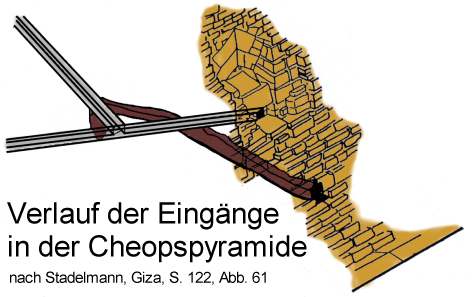
Also missing: The horizontal passage, the queens chamber, the descending passage, the lower chamber and the passage to the relieving chambers of the kings chamber. They're all not accessible for tourists. The tour covers what you would see as a normal visitor (not ie an archeologist with special permission).
It's the pyramid of Khufu, 2nd king of the 4th dynasty. None of the pyramids of the 4th dynasty have hieroglyphs. That slowly came into fashion in the 5th (or 6th? Too lazy to check) dynasty. If you measure ancient egypt from the 1st dynasty to Cleopatra, you come up with roughly 3000 years. This pyramid was built around the year 500 on that scale. There is not much writing left at all from that period. The palermo stone being one example: https://en.wikipedia.org/wiki/Palermo_Stone The most exiting recent find is the diary of Merer: https://en.wikipedia.org/wiki/Diary_of_Merer It seems he was a middle manager in transporting stones to this, Khufus pyramid, which makes his writings the closest you can get to an eye witness account of the construction.
Exactly the same for me, I'm forever grateful.