energywut
Joined 1 year ago
Karma
242
Submissions
73
Member since
May 8
Joined 1 year ago
Which lawsuit PDF related specifically to iMessage interacting with Android was mentioned in this comment? I see a comment about RCS.
Now, maybe you are right, maybe I narrowly interpreted RCS in iMessage to mean chat bubbles, and there's a wider interpretation. Even still, there's no possible way that's the singular most evil thing tech has ever done. The OP is free to be anti-Apple, more power to them, but like, let's be real about levels of evil.
> Also, bringing up IBM, Microsoft or Facebook is "whataboutism".
It's absolutely not whataboutism. The claim the OP made was about Big Tech broadly. Bringing in examples of Big Tech doing evil things is a direct and appropriate rebuttable to the argument that Big Tech doesn't do evil things.
That's not what the parent is asking. The OP said it was the most evil ever done.
Big Tech does predatory and evil stuff all the time. That's not what's being claimed. The OP is claiming that this specific thing is the worst, the singular event that is above and beyond all others.
I think you might be living in a bubble, if this is the "most evil" thing you have heard of a big tech company doing. Go read up on IBM's history, especially in the 30s and 40s. Or a more contemporary example, read up on Embrace, Extend, Extinguish. Or Amazon's mistreatment of workers in both corporate and warehouse settings. Or Meta scraping data off your devices without permission to train AI.
And, though I know some folks here disagree, plenty of people around the world believe what's happening in Gaza is a genocide, and Big Tech has materially contributed to making it happen. Or, if you want another example of human cost, talk about how resources for electronics are mined, or how electronics are manufactured.
Saying, "the most evil thing big tech has ever done is make some chat bubbles blue" puts a whole lot of human lives below the color of some chat bubbles.
You can think Apple did a really bad thing by doing that, that's fine. No complaints. But to call it the most evil thing ever done erases an incalculable amount of human suffering.
I did not read this claim. I read the claim that Apple's approach unevenly benefits companies that engage in surveillance capitalism. No one's ad revenue, for instance, must pay a 30% cut of their revenue.
You are making an argument (and then arguing against it) that Proton did not make, as far as I can read.
> if you make the platform that others run on and which creates entirely new economies and allows businesses to thrive, don’t you get to define the constraints that you want since it’s _your_ platform?
I don't think you do. We constrain what companies are permitted to do all the time. Apple must abide by regulatory constraints first, and then they can add the additional constraints they like.
A simple test -- could Apple say, "Everyone is allowed to use Messages, except Hindus"? It's their platform, don't you get to define the constraints because it's your platform? No, we've collectively decided that kicking some people out based on certain characteristics is generally bad.
Nope, just the left handed people I know.
Reliable energy? Possible, but difficult -- need plenty of batteries
Cooling? Very difficult. Where does the heat transfer to?
Latency? Highly variable.
Equipment upgrades and maintenance? Impossible.
Radiation shielding? Not free.
Decommissioning? Potentially dangerous!
Orbital maintenance? Gotta install engines on your datacenter and keep them fueled.
There's no upside, it's only downsides as far as I can tell.
I'm saying that prison sentences are not a deterrent to crime, and, in fact, increase the amount of crime done. Research has consistently shown that the threat of being caught is considerably higher deterrent than prison time, and that harsh sentences don't influence behavior:
https://nij.ojp.gov/topics/articles/five-things-about-deterr...
> That has nothing to do with the point I made, which was about people becoming criminals.
We are discussing crime. Which has a total sum. You can reduce that sum by preventing people from being criminals or you can reduce that sum by reforming criminals. I believe you need both. So it is important to remember that prisons negatively contribute to reforming people, increasing total crime, while research shows they don't contribute to preventing people from being criminals.
We need other systems, systems that prevent people from becoming criminals AND reduce the likelihood of re-offending if they do.
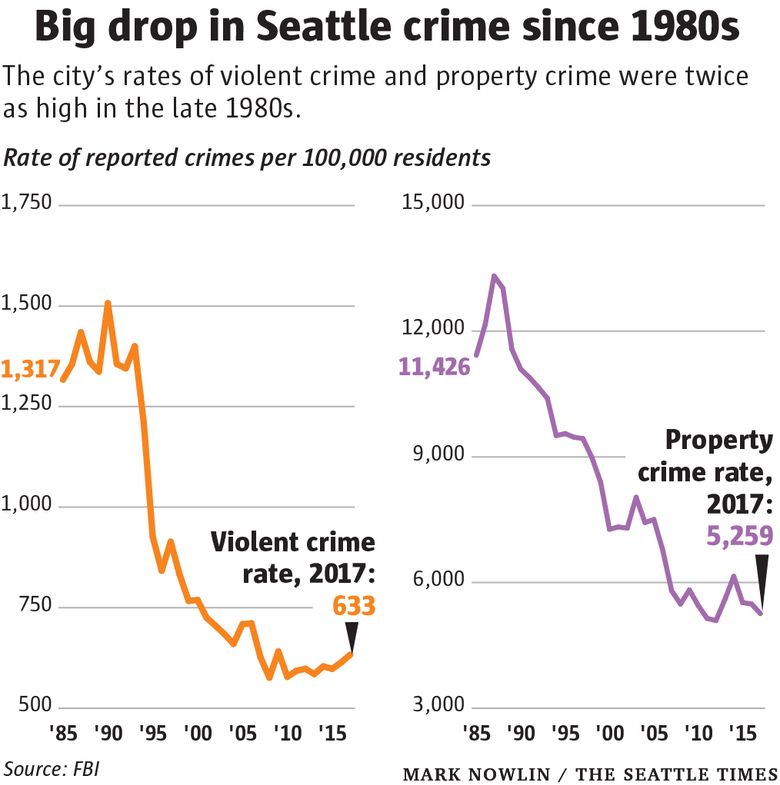
In the 80s and 90s, violent crime rates were well above 1000/100k residents, and property crimes 12k/100k.
Here is a study supporting the assertion that prisons increase (or do not reduce) the likelihood of someone reoffending in the future. https://www.journals.uchicago.edu/doi/10.1086/715100
Your claim that prisons reduce the likelihood of the population at large is not obvious on its face, as the US has very high rate of incarceration, but still has moderately high crime rates. Can you supply some data?
Police reports aren't the only source of data. If this was a widespread impact then there would be other sources of data that could be used to build this case.
Additionally, we cannot make policy decisions on "just trust me, my friend said...". Maybe we can't get a perfect signal, but if you are going to challenge the prevailing data, I expect you to bring something novel beyond vibes. It doesn't have to be perfect, but a single anecdote plus "I believe it" is not sufficient to oppose what the data we do have is consistently saying -- crime is lower in Seattle, and has been consistently lowering over time.