
elBoberido
Joined 2 years ago
Karma
17
Submissions
16
Member since
Apr 15
Open source enthusiast, iceoryx maintainer and co-founder of ekxide
View on Hacker NewsJoined 2 years ago
Like another poster already commented, while iceoryx2 is implemented in Rust, it already support other languages, like C, C++, C# and Python. We'd love to add even more languages to the list, with Go being on top of our wishlist, but like always with OSS, someone needs to do the work or needs to step up and fund the work.
Yes, there is some overlap but iceoryx and threadprocs could complement each other. Currently, we achieve true zero copy only with data types that are shared memory compatible, i.e. no heap, no self references, etc., basically the data type must be memcopyable. Cap'n Proto or the Apache Arrow columnar format would also work. For other data, e.g one that uses the heap, there would still a serialization step be required but at least there is no further copy between the processes.
With threadprocs, it would be possible to also send data structures that use the heap or are self-referential. iceoryx2 already works in the same way as the proposed solution for the deallocation. There is a submission channel to provide the data and a completion channel where the pointer are sent back to the producer. Currently, we do not call any d'tor, since it is not necessary, but that should not be too difficult to implement.
If that’s the case, I want to reassure you that we don’t use locks. Quite the contrary, we use lock-free[1] algorithm to implement the queues. We cannot use locks for the reason you mentioned and also for cases when an application dies while holding the lock. This would result in a deadlock and cannot be used in a safety critical environment. Btw, there are already cars out there which are using a predecessor of iceoryx to distribute camera data in an ECU.
For hard realtime systems we have a wait-free queue. This gives even more guarantees. Lock-free algorithms often have a CAS loop (compare and swap), which in theory can lead to starvation but it's practically unlikely as long as your system does not run at 100% CPU utilization all the time. As a young company, we cannot open source everything immediately, so the wait-free queue will be part of a commercial support package, together with more sophisticated tooling, like teased in the blog post.
Regarding memory guarantees. There are essentially the same guarantees like what you have when sharing an Arc<T> via a Rust channel. After publishing the producer releases the ownership to the subscriber and they have read-only access for as long as they hold the sample. When the sample is dropped by all subscriber, it will be released back to the shared memory allocator.
Btw, we also have an event signalling mechanism to not poll the queue but wait until the producer signals that new data is available. But this requires a context switch and it is up to the user to decide if it is desired to have.
What are you needing request-response for?
I second that. It took us quite some time to get the correct architecture. After all, iceoryx2 is the third incarnation of this piece of software, with elfepiff an me working on the last two.
> 1. Unless you're using either fixed sized or specially allocated structures, you end up paying for serialization anyhow (zero copy is actually one copy).
Indeed, we are using fixed size structures with a bucket allocator. We have ideas on how to enable the usage on types which support custom allocators and even with raw pointers but that is just a crazy idea which might not pan out to work.
> 2. There's no way to reference count the shared memory - if a reader crashes, it holds on to the memory it was reading. You can get around this with some form of watchdog process, or by other schemes with a side channel, but it's not "easy". > > 3. Similar to 2, if a writer crashes, it will leave behind junk in whatever filesystem you are using to hold the shared memory.
Indeed, this is a complicated topic and support from the OS would be appreciated. We found a few ways on how to make this feasible, though.
The origins of iceoryx are in automotive and there it is required to split functionality up into multiple processes. When one process goes down, the system can still operate in a degraded mode or just restart the faulty process. With this, one needs an efficient and low-latency solution else the CPU is spending more time on copying data than on doing real work.
Of course there are issues like the producer mutating data after delivery, but here are also solutions for this. It will of course affect the latency but should still be better than using e.g. unix domain sockets.
Fun fact. For iceoryx1 we supported only 4GB memory chunks and some time ago someone came and asked if we could lift this limitation since he wanted to transfer a 92GB large language model via shared memory.
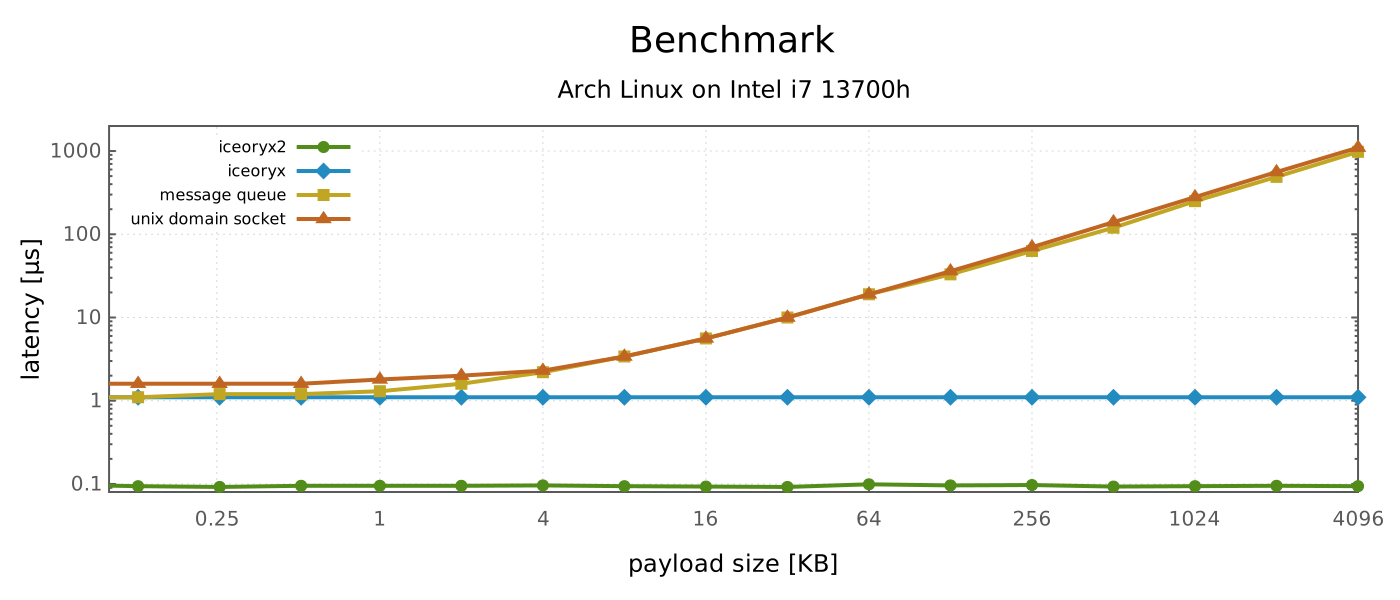
~~It's nice to see that independent benchmarks are in the same ballpark than the one we perform.~~ Edit: sorry, I confused your link with another one which also has ping-pong in its title
We provide data types which are shared memory compatible, which means one does not have to serialize/deserialize. For image or lidar data, one also does not have to serialize and this is where copying large data really hurts. But you are right, if your data structures are not shared memory compatible, one has to serialize the data first and this has its cost, depending on what serialization format one uses. iceoryx is agnostic to this though and one can select what's the best for a given use case.
[1]: https://raw.githubusercontent.com/eclipse-iceoryx/iceoryx2/r... [2]: https://github.com/eclipse-iceoryx/iceoryx2
With this release we have initial support for C and C++. Not all features of the Rust version are supported yet, but the plan is to finish the bindings with the next release. Furthermore, with an upcoming release we will make it trivial to communicate between Rust, C and C++ applications and all the other language bindings we are going to provide, with Python being probably the next one.
Reading your response is almost as you've been at our coffee chats. Quite some of your ideas are also either already implemented in iceoryx2 or on our todo list. It seems we just put our focus on different things. Here and there you also added the cherry on top. This motivates us to improve on some areas we neglected the last years. We can learn from each other and improve our projects thanks to the beauty of open source.
Keep up the good work
We started with mapping to the shm to the same address but soon noticed that it was not a good idea. It works until some application already mapped something to the same address. It's good that you did not went that route.
I hoped you had an epiphany and found a nice solution for the raw-pointer problem without the need to change them and we could borrow that idea :) Replacing the raw-pointer with fancy-pointer is indeed much simpler than replacing the whole logic.
Since the raw-pointer need to be replaced by fancy-pointer, how do you handle STL container? Is there a way to replace the pointer type or some other magic?
Hehe, we have something called 'relative_ptr' which also tracks the segment ID + offset. It is a struct of two uint64_t though. Later on, we needed to condense it to 64 bit to prevent torn writes in our lock-free queue exchange. We went the same route and encoded the segment ID in the upper 16 bits since only 48 bits are used for addressing. It's kind of funny that other devs also converge to similar solutions. We also have something called 'relocatable_ptr'. This one tracks only the offset to itself and is nice to build relocatable structures which can be memcopied as long as the offset points to a place withing the copied memory. It's essentially the 'boost::offset_ptr'.
Btw, when you use jemalloc, do you free the memory from a different process than from which you allocate? We did the same for iceory1 but moved to a submission-queue/completion-queue architecture to reduce complexity in the allocator and free the memory in the same process that did the allocation. With iceoryx2 we also plan to be more dynamic and have ideas to implement multiple allocators with different characteristics. Funnily, jmalloc is also on the table for use-cases where fragmentation is not a big problem. Maybe we can create a common library for shm allocating strategies which can be used for both projects.