

einr
Joined 11 years ago
Karma
1,961
Submissions
580
Member since
Mar 31
Joined 11 years ago
Especially curious because I see a whole lot of hardcoded english text in there…
https://ghloc.vercel.app/thunderbird/thunderbolt?branch=main claims 141k and most of it is Typescript.
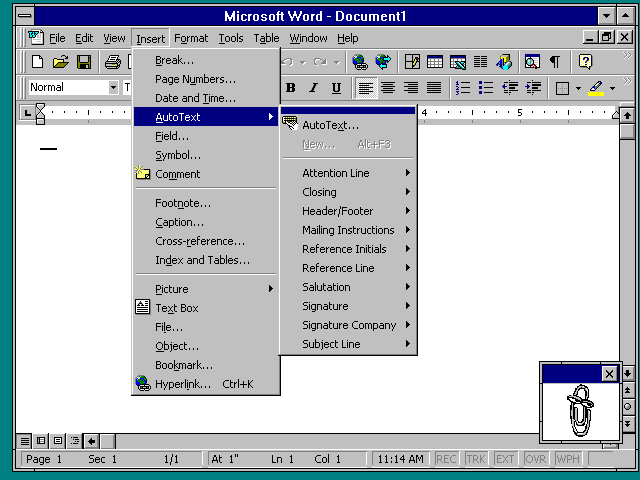
The menu bar in Office 2000 does not look like the standard OS menu bar, for instance. The colors, icons and spacing are non-standard. This is only slightly jarring, because it's pretty well done, but it's still inconsistent with every other app.
This was kind of the beginning of the end for Windows consistency -- when even Microsoft thought that their own toolkit and UX standards were insufficient for their flagship application. Things have only become worse since then.
* This becomes very obvious when you run Office 97 on NT 3.51, which generally looks like Windows 3.1, but since Office 97 renders itself and does not care about OS widgets, it looks like this: http://toastytech.com/guis/nt351word.png
The full name on the chip on some of them is ”Am5x86-P75 DX5-133” which implies a lot of things, some of which are flat out misleading (it does not get very close to ”P75” performance)
https://en.wikipedia.org/wiki/Amiga_Hombre_chipset
It was going to be HP PA-RISC based and have an AGA Amiga SoC, including a 68k core.
Maybe if these theoretical new 68k Amigas became a huge market hit they could have taken the arch further and it could have remained competitive, but all the other 68k shops had already pretty much given up or moved on already (Apple was already going PPC, Sun went SPARC, NeXT gave up on their 68k hardware, Atari was exiting the computer business entirely, etc) so I don’t know that the market would have been there to support development against the vast amount of competition from both the huge x86 bastion on one hand and the multitude of RISC newcomers on the other.
Second gen Pentiums, starting with the 75 MHz, were great.
(Also, a Pentium 60 is barely faster than a DX/2 66 at many tasks — it is a Bad Processor — but that’s another conversation ;)
Nevertheless, AI use is not what really stood out to me. It’s that it’s SO MUCH CODE. I have no idea how you guys maintain or reason about the quality or security of something like this. Good luck, I guess.