

drmpeg
Joined 12 years ago
Karma
1,737
Submissions
442
Member since
Dec 24
Joined 12 years ago
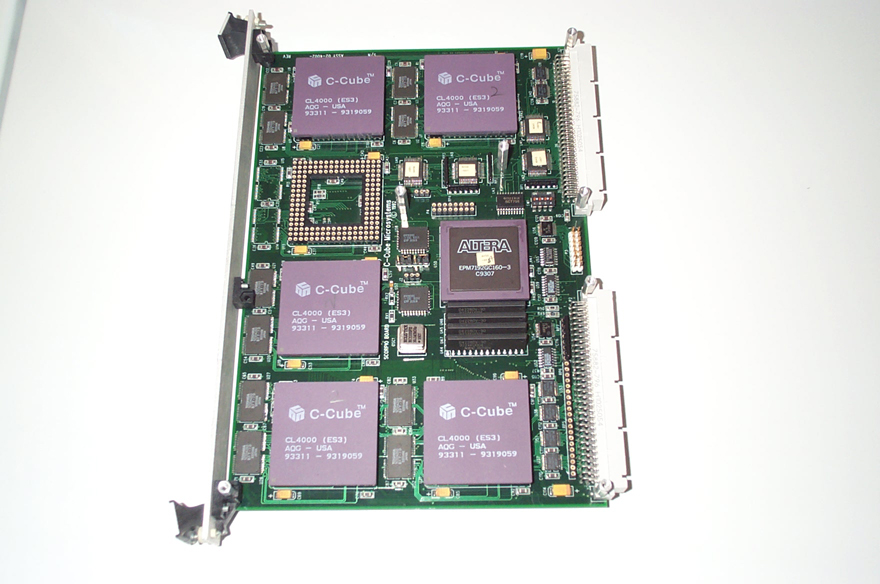
Here's a picture of the VME bus development board. It was a two board sandwich to support 10 chips in parallel (only one board pictured).
https://www.w6rz.net/scorpio.jpg
The first real-time HDTV encoders for terrestrial digital television (ATSC) were built by Harris using an IBM encoder chip. It took 6 chips to encode 1920x1080. The IBM chips didn't have an auxiliary bus, so you could see motion vectors limited to chip image boundaries (in this case, 6 tiles arranged like so).
  -------------------------
  |       |       |       |
  |   1   |   2   |   3   |
  |       |       |       |
  -------------------------
  |       |       |       |
  |   4   |   5   |   6   |
  |       |       |       |
-------------------------https://www.spaceweatherlive.com/en/solar-activity/top-solar...
I had a lot of fun there. The purchasing manager was a Scottish guy and he had an after hours drinking club in a small conference room with a wet bar. I was only 24 years old and working crazy hours. I'd get a few beers around 7 pm and then go back to work writing 8080 assembly language code for a few more hours.
I also ended up smoking weed with the CEO and CFO a couple of times. The CFO was not a young guy. I'm not sure how old he was, but he had all white hair. The CEO gave me a mason jar full of his homegrown weed as a gift when I finished the project.
That company and even the building is long gone. It's now a Google parking garage.
I'm not sure if they used the 8" cartridges all the way to 2005, but I can find out. I'm still friends with the original system maintainer. I pivoted to video compression in 1993 and lost track of the program, but we found each other on Facebook in 2010.
https://lore.kernel.org/lkml/2026050851-iron-hurdle-6421@gre...
https://lore.kernel.org/lkml/2026050843-unplowed-spinster-cf...
https://lore.kernel.org/lkml/2026050832-remold-faceless-bed0...
https://lore.kernel.org/lkml/2026050825-heaving-spender-13a8...
https://github.com/torvalds/linux/commit/0d6dd4738dbcc32b60c...

https://en.wikipedia.org/wiki/Intel_Quick_Sync_Video