dps
Joined 17 years ago
Karma
933
Submissions
76
Member since
Mar 31
http://www.linkedin.com/in/davidpsingleton
http://blog.singleton.io/
http://www.twitter.com/dps
View on Hacker NewsJoined 17 years ago
Fun to see this post from the deep archive get some interest - thanks for reading!
I do still read the code _except_ when I am consciously vibe coding a non production thing where I will know empirically that it worked or not by using it.
I’m definitely not using agents to do all my coding (as I hope is reasonably) clear from the post. But they have crossed this line from pointless to try to genuinely useful for many real world problems in just the last couple of months in my experience.
I enjoyed completing AoC this year. While it was very clear that day 1 (esp. part 2) was significantly harder than previous years (I wrote about this among other things [0]), OP's claim seemed not obviously self evident when comparing _current_ 2022 stats to _current_ 2023 stats, as folks have had an additional full year to complete the 2022 puzzles.
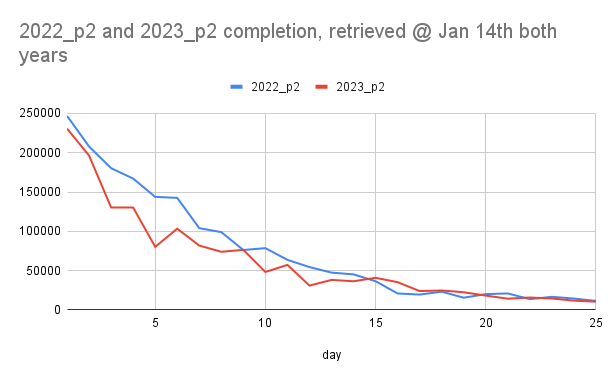
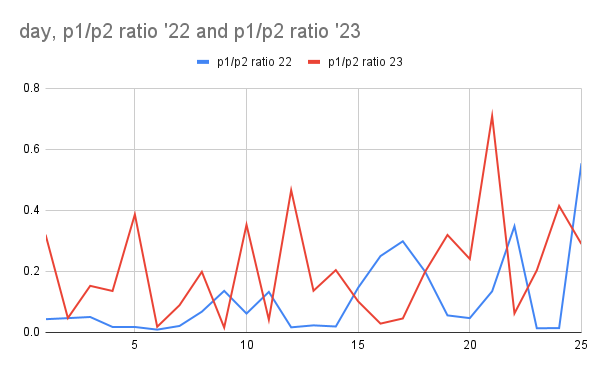
I grabbed the 2022 stats from Jan 14th 2023 [1] and, indeed, the difference is quite stark. Graphing the part two completion stats[2] for both years, there was a relatively similar starting cohort size on day 1, but 2023 looks clearly harder than 2022 up until day 15. As OP observes, the ratio[3] of folks completing pt1 but not going on to complete pt 2 is way higher for a lot of days in 2023 and suggests the day 5, 10, 12 and especially day 22 part 2s were particularly difficult.
[0] https://blog.singleton.io/posts/2024-01-02-advent-of-code-20...
[1] https://web.archive.org/web/20230114172513/https://adventofc...
[2] https://blog.singleton.io/static/imgs-aoc23/completion.png
That's a reasonable question. We wrote this RCA to help our users understand what had happened and to help inform their own response efforts. Because a large absolute number of requests with stateful consequences (including e.g. moving money IRL) succeeded during the event, we wanted to avoid customers believing that retrying all requests would be necessarily safe. For example, users (if they don’t use idempotency keys in our API) who simply decided to re-charge all orders in their database during the event might inadvertently double charge some of their customers. We hear you on the transparency point, though, and will likely describe events of similar magnitude as an "outage" in the future - thank you for the feedback.
Thanks for the questions. We have testing procedures and deploy mechanisms that enable us to ship hundreds of deploys a week safely, including many which touch our infrastructure. For example, we do a fleetwide version rollout in stages with a blue/green deploy for typical changes.
In this case, we identified a specific code path that we believed had a high potential to cause a follow-up incident soon. The course of action was reviewed by several engineers; however we lacked an efficient way to fully validate this change on the order of minutes. We're investing in building tooling to increase robustness in rapid response mechanisms and to help responding engineers understand the potential impact of configuration changes or other remediation efforts they're pushing through an accelerated process.
I think our engineers’ approach was strong here, but our processes could have been better. Our continuing remediation efforts are focused there.