

dabluecaboose
Joined 4 years ago
Karma
1,644
Submissions
482
Member since
Jan 14
Joined 4 years ago
STS-51-F is the only exercised launch abort, and the Challenger was the orbital vehicle.
STS-51-L, which occurred the following year, is the famous Challenger disaster.
Originally, the numeral in the mission designation indicated the federal fiscal year of the mission and the launch site (51 being 1985 and launch site 1 (KSC, 2 would have been used for Vandenberg). The letter indicated the sequential launch index, so A=1m, B=2, etc.
This was originally done after STS-12. Superstition around Apollo 13 created the desire to avoid an STS-13. The numbering system returned to a strictly sequential schema after STS-51-L, with STS-26.
You're completely welcome to make a post that raises those questions, but I think its irrelevant here. I don't think its productive for every fun project posted to have an inquisition in the comments on whether or not the project deserves to exist.
> May I suggest the problem is not with the questions then?
It's against the guidelines to make swipes like this.
Thanks for sharing this awesome project!
A rocket engine bell is a supersonic nozzle. Subsonic nozzles, like on your garden hose, typically go from wider to narrower to increase pressure and velocity of the exiting flow. Supersonic nozzles generally narrow to a point; This point is calculated to be exactly where the exhaust stream reaches Mach 1 (Supersonic flow). Once a flow is supersonic, it behaves differently and somewhat counter-intuitively. The nozzle widens to increase velocity and decrease pressure. The bigger the engine bell, the less the pressure is at the exit, and the faster the flow.
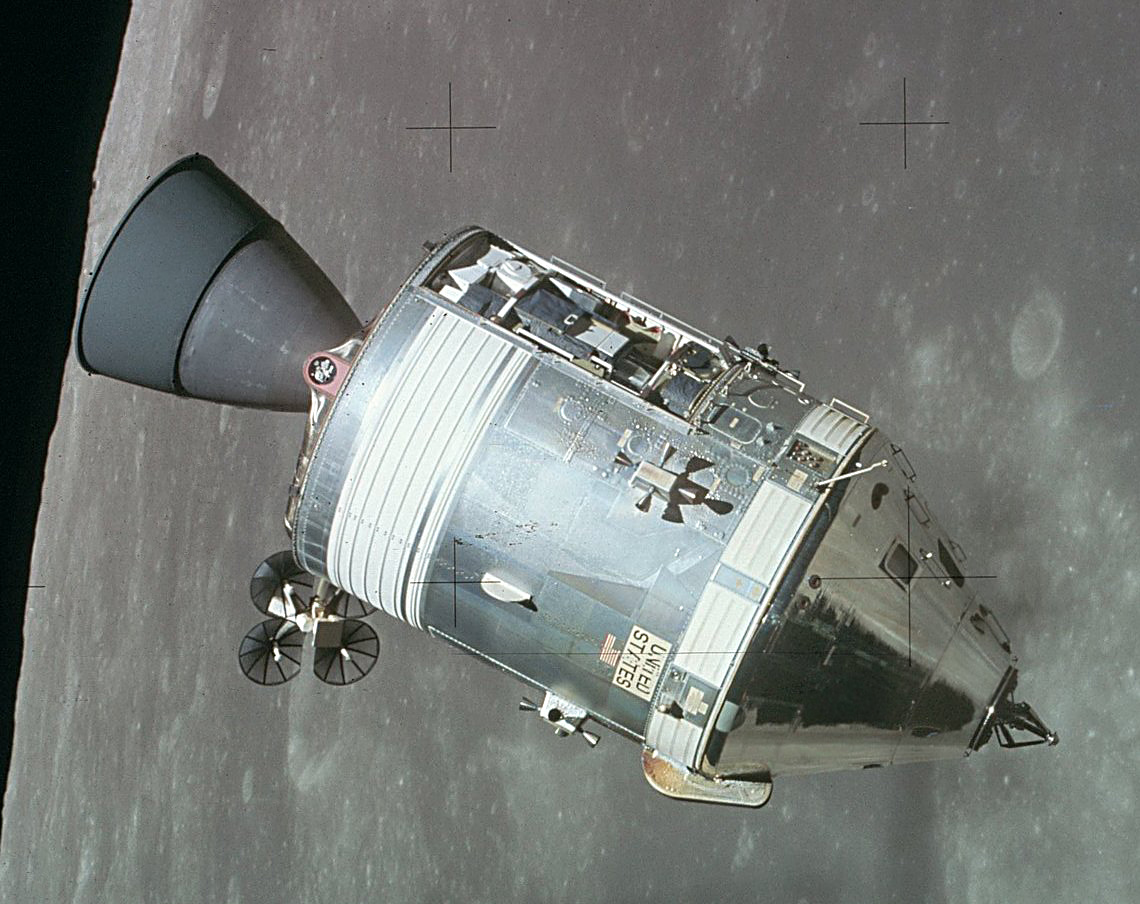
Generally, rocket engine bells have one ambient pressure value that they produce optimal thrust at. This is equivalent to the exit pressure at the very end of the bell. Take a look at the engine bell for the Apollo service module- It's quite large in order to expand the flow as much as possible to perform well in a vacuum (Very low pressure)[1].
If the ambient pressure is higher than the exit pressure, your flow is underexpanded and you get shock diamonds, as seen here [2]. The SR-71's engines were optimized for a higher altitude/lower pressure, so on takeoff the ambient pressure is pushing "inward"; the flow is underexpanded.
If the ambient pressure is lower than the exit pressure, and you see a large plume expanding outward from the nozzle, as seen here [3]. The flow is pushing "outward" at a higher pressure than the ambient; the flow is overexpanded.
Most rocket engines are optimized for an altitude/pressure ~midway through the stage's lifetime, so they're underexpanded at launch and overexpanded at engine cut-off. You can see in both examples that the velocity vector of the escaping flow isn't parallel to the rocket- it's going inward (underexpanded) or outward (overexpanded). This is the source of inefficiency with respect to engine bells.
---
The main advantage of an aerospike is that the ambient pressure effectively provides the outer shell of the engine bell- the flow is always optimally expanded at every altitude. This means you don't need to pick an optimal "midpoint" to design your engine around- the flow is always optimal from launch to orbit.
This massive upside comes with a downside. Staging generally provides two advantages to a rocket: The ability to shed dead mass, and the ability to "upgrade" to a more optimal engine bell. With an aerospike, you have an expensive engine that you don't want to drop (because it's perfectly efficient at every altitude) but now you have to figure out how to shed the dead mass as you go.
Personally, I've always envisioned an aerospike working well on a Space Shuttle type vehicle- the engines are kept and the fuel tanks are discarded. I'm interested to see if aerospike development comes with a change in how we see launch vehicles in the post-shuttle era that's largely dominated by disposable or VTOL-recoverable first stages.
[1] https://upload.wikimedia.org/wikipedia/commons/c/c0/Apollo_C...
[2] https://upload.wikimedia.org/wikipedia/commons/thumb/d/d3/SR...
[3] https://upload.wikimedia.org/wikipedia/commons/e/e2/Apollo_1...


Dilettante in much, expert in some.