

cmontella
Joined 12 years ago
Karma
1,038
Submissions
220
Member since
Sep 2
Joined 12 years ago
There is! As of now, if you sort by recently updated, my literate programming project is the first result :P (link in profile if anyone reads this later)
Note the LLMs are trained on language semantics far beyond the mainstream ones, so language design can become quite exotic without straying too much from the training. You really do have to measure these things, I don’t see how you can make a confident assertion without data.
https://mech-lang.org/iros-r4r-2026/index.html#5805406811462...
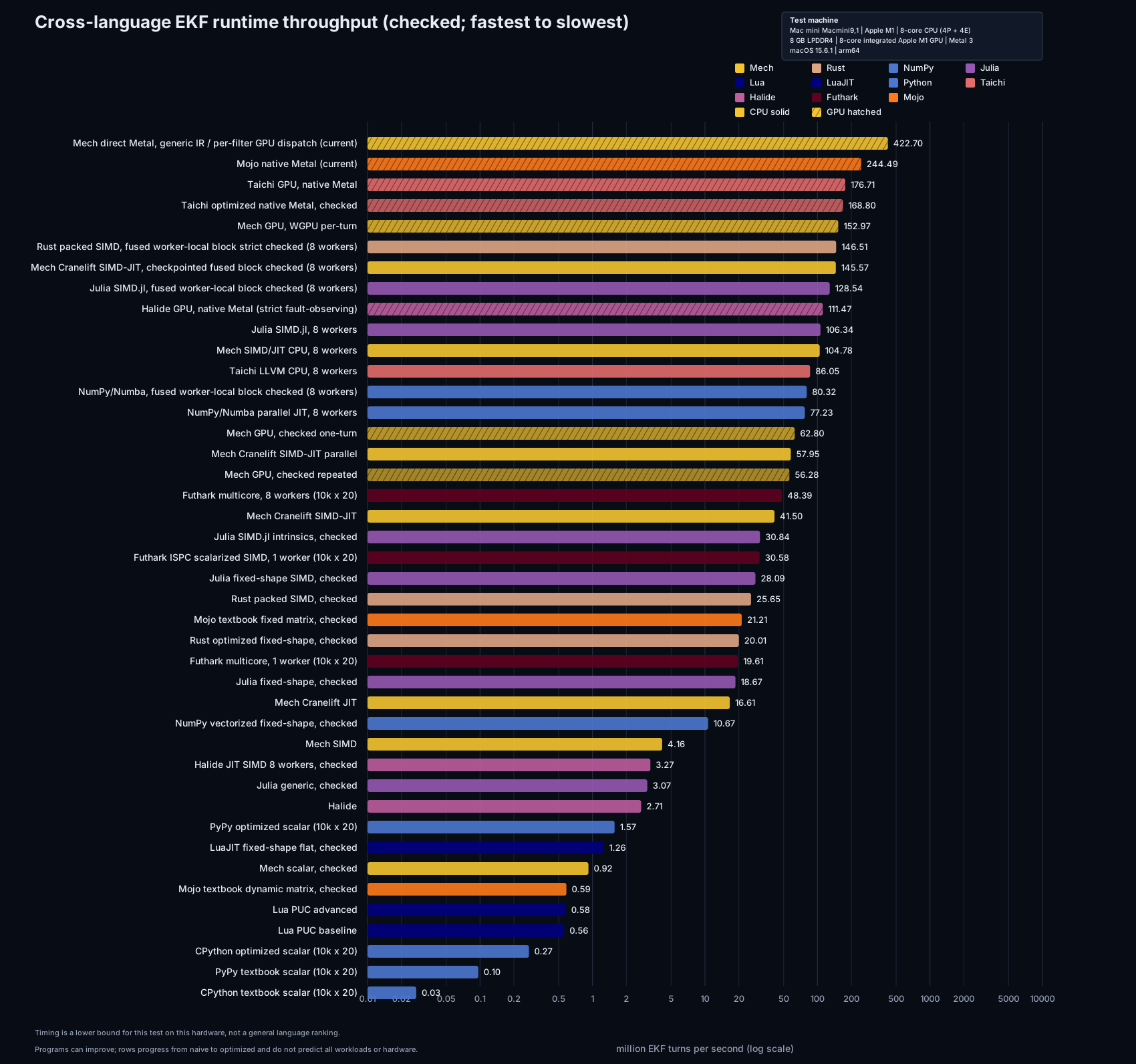
I compare one algorithm across several programming languages and backends. There is no training data for Mech in the LLM yet it beats most other implementations in perf, which were optimized by LLM.
Maybe human performance engineers trained in these languages could write better implementations. But to answer the question of whether the LLM could write more performant code in languages it’s trained in versus languages it’s not, this comparison is at least illustartive.
That’s an interesting idea about an aromas transition, I’ll have to think about that. I put state machines in the language for better static program analysis and tracing, I think the aromas idea could complement that. What do you see as the main utility?
Have you written about your work anywhere else?
I'm with you there, I think I starred Oct when I came across it. I've been on that quest since 2014, we should collaborate! I'll be presenting this work at IROS tomorrow, I'd love to hear what you think: https://mech-lang.org/iros-r4r-2026/index.html
I added PyPy and Mojo.
PyPy performs valiantly compared to Cpython -- even better than LuaJIT. I'm sure someone skilled at writing it could do an even better job.
I measured 3 Mojo implementations. The first is a dynamic implementation, it performs like a typical dynamic language. Then when you use Mojo's SIMD intrinsics you can get compiled-tier performance in line with Futhark, Julia, Rust etc.
Then if you use their Max toolchain you can compile Mojo directly to Metal, with performance at the top of the stack (for the amount of money Qualcomm paid they'd better be there!).
The Rust / Mech version was rewritten to put it back on top, but the unchecked test is about equal. Basically if a toolchain can emit direct Metal code there's nothing preventing equal performance it seems, so the magic is in the compiler. Although there is some abstraction overhead depending on how you get there e.g. going wgpu->Metal has a penalty over going directly to Metal.
The big disclaimer again is that all of these measurements should be taken as lower bounds for one algorithm on one machine. I'm sure expert performance engineers could do better.
Author of: https://github.com/mech-lang
Past Projects:
https://github/witheve