

aoner
Joined 9 years ago
Karma
106
Submissions
104
Member since
Jan 17
Joined 9 years ago
There are alternative models, such as biocyclic veganic agriculture, or in the future, foods created through fermentation [1] (this almost require no arable land). I recommend checking them out if you are interested in cycles in nature. Using animal manure, opposed to "plant manure" from nitrogen fixing plants, it also has its downsides because of the high levels of ammonia it kills most of the soil creatures such as worms, and more tilling and maintenance is required (which releases more carbon).
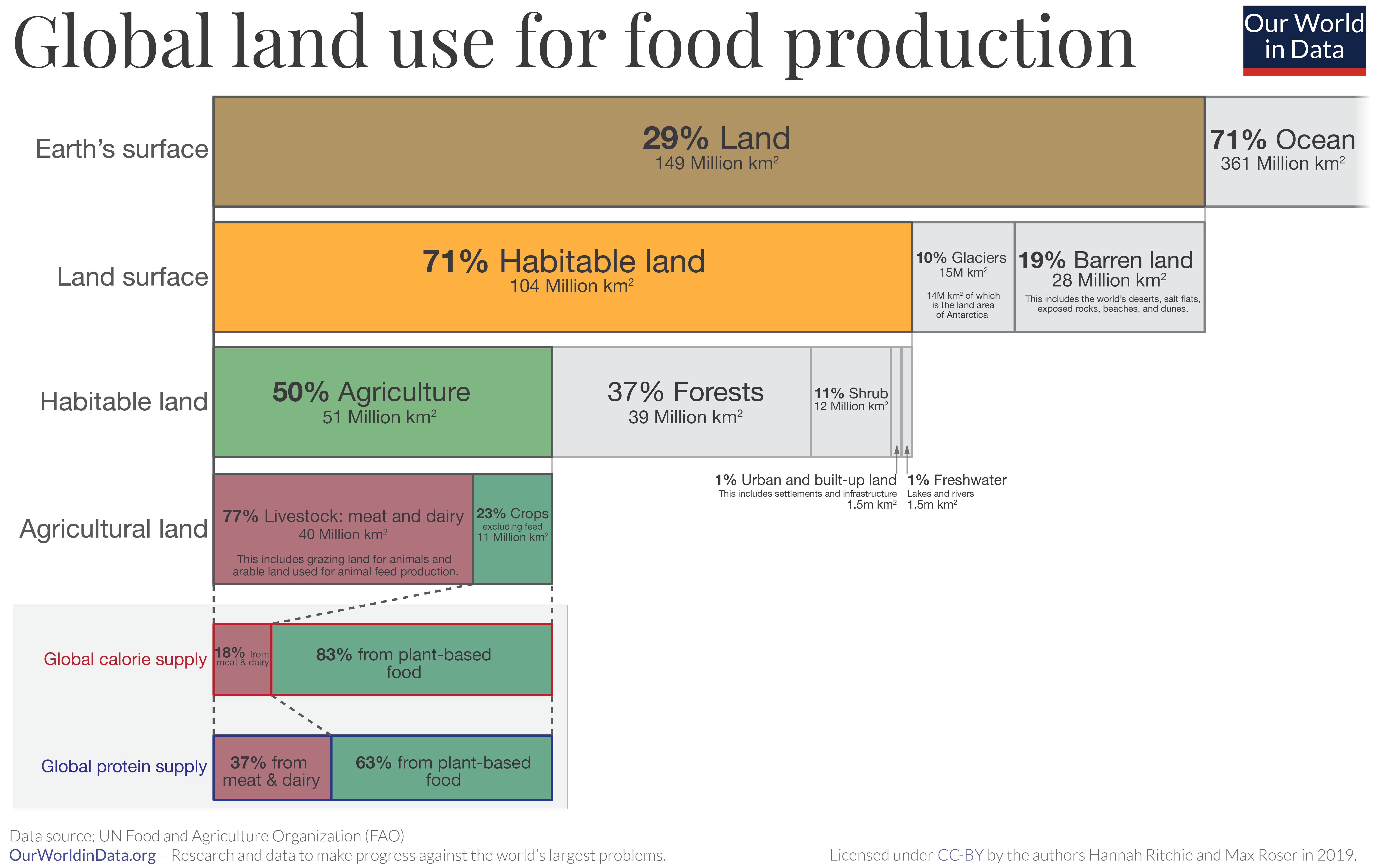
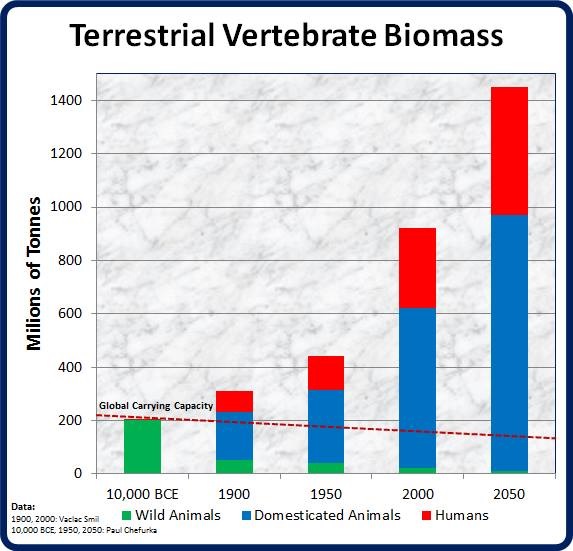
Personally I don't think that using livestock is living with nature, but is its antithesis. Since the earth is (at this moment) bound by the amount of biomass available through photosynthesis there is a limited carrying capacity for biomass. What we have done specifically is reduced the biodiversity by using more and more land mass for livestock and its feed. Of all habitable land, 50% is used for agriculture and 77% of that is used for livestock (while only providing us 18% of calories and 37% of protein) [2]. This has drastically reduced the number of wild animals and biodiversity, which I consider "nature" [3].
Ultimately, using livestock kills living beings (primarily in nature) somewhere else. If you're goals are living closer to nature, and reducing your ecological footprint, and your definition of nature is: "the phenomena of the physical world collectively, including plants, animals, the landscape, and other features and products of the earth, as opposed to humans or human creations.", then living closer to nature would mean rewilding your land and perhaps be a steward of that land. It would be a great means of treating nature and life with more respect :).
[1]: https://www.theguardian.com/environment/2021/jun/21/microbes... [2]: https://ourworldindata.org/uploads/2019/11/Global-land-use-g... [3]: https://peakoilbarrel.com/wp-content/uploads/2017/11/Terrest...
If everyone in the world would eat the recommended USDA diet (mostly backed by industry and totally not healthy for you) we'd need another Canada to sustain us all [4]. By the way, most of the grasslands are man-made and we should try and reforest those areas to combat losses in biodiversity and climate collapse. Furthermore about a third of all fresh drinking water (not rainwater) is used for cattle [5].
[1]: https://rainforests.mongabay.com/0812.htm / https://scholar.google.nl/scholar?hl=en&as_sdt=0%2C5&q=defor...
[2]: http://peakoilbarrel.com/carrying-capacity-overshoot-and-spe...
[3]: https://www.ipbes.net/news/Media-Release-Global-Assessment
[4]: https://journals.plos.org/plosone/article?id=10.1371/journal...
[5]: http://www.takepart.com/article/2016/02/18/4-billion-people-...
Do note that a lot of pro-milk studies are industry backed. The new Canadian food guide has discarded all industry backed studies and based on science created a new food guide [3]. This food guide removed the "recommended" glass of milk based on these studies with water.
[1]:https://link.springer.com/article/10.1023/A:1008823601897
[2]: https://www.ncbi.nlm.nih.gov/pubmed/16125328?dopt=Citation
[3]: https://www.treehugger.com/green-food/canadians-would-rather...
Synthetic fuels will make most sense for aviation (higher energy density compared to hydrogen), (possibly) shipping and as a transitional fuel for transport to reduce our emissions.
Synthetic fuels could also be a solution for seasonal storage.
Australia had the world’s 15th largest greenhouse gas emissions in 2015 and its citizens’ per-capita contribution is around three times the global average.
It is the world’s second largest coal exporter and recently became the top exporter of liquified natural gas (LNG). Its electricity system remains heavily reliant on coal, despite ramping up the use of gas and renewables, especially rooftop solar.
It is also highly vulnerable to the effects of climate change, including extreme heat, drought, bushfires and agricultural impacts.
Based on its current trajectory, Australia is off track on its international pledge to cut emissions 26-28% by 2030 compared to 2005 levels.
I highly recommend carbonbrief in general
Also if we've improved this technology so that the costs are reduced (50$ per ton) we can do proper negative emissions in a scalable way without many downsides (can be used in non-arable land, no water consumption with low temperature direct air capture actually has water as a co-product which we can use for electrolysis). We could then sequester the carbon dioxide underground or even create carbonates out of them so we can store them safely in concrete or asphalt in the form of aggregates.
Feel free to contact me :) adnanoner at gmail . com