

Strilanc
Joined 16 years ago
Karma
5,208
Submissions
1,118
Member since
Jun 22
Joined 16 years ago
Something that is like SIMD in quantum computing is that if a block code supports a transversal operation then it is far cheaper to apply that operation to every qubit in the block than to selectively target one of them with the operation.
[1]: https://chemistry.stackexchange.com/questions/62001/why-is-c...
One of the most important things to realize when optimizing quantum algorithms is this: approximations are overpowered. The difference between 99.99999% accurate and 100% accurate can be a factor of 10 in cost. And there's lots of places where a 90% accurate algorithm is more than good enough.
1. Collisions aren't as bad as preimage attacks
2. Even if you made a file-with-malicious-hash, how would you get people to pull it?
3. Other attacks are a bigger problem (social engineering)
(2) is laughable in a world with github. It's common for unknown people to submit pull requests to code bases, and for those changes to be reviewed and merged. For example, as part of reviewing pull requests, I have `git fetch`'d proposed changes to my local machine to check behavior on some additional test cases. "If you fetch it you're fucked" is unacceptable as a security boundary.
(1) and (3) are just tu-quoque arguments about other attacks being worse. The relevant question isn't how bad other attacks are, it's how bad this attack is.
The fundamental problem with collisions is that software often assumes they can't happen (or is not tested against them). Thus collisions can trigger bugs, or otherwise cause surprising behavior. For example, webkit figured the colliding PDFs demonstrating a sha1 collision would be excellent for unit tests, so they merged the PDFs into their SVN repo... which completely fucked it [1]. I don't know the exact internals of git so I can't comment on how you would get surprising things to happen, but "oops the file you merged was different than the file you reviewed" and "oops the repository got corrupted" seem entirely plausible.
[1]: https://www.reddit.com/r/programming/comments/5vyhy2/webkit_...
Keep in mind employees at AI companies are publicly stating that they believe they're risking a >10% chance of human extinction. They're knowingly risking the lives of every man, woman, and child to continue the work. The lives of their own sons and daughters. A person already rationalizing that isn't going to shed a tear for the careers of mathematicians. Just a bug on the windshield.
Really what matters about this chip is that it is better suited for error correction. They have a square grid connectivity (previous IBM chips incurred fatal overheads from their heavy hex connectivity), they can actually reset their qubits now (previous IBM chips couldn't scale to long running computations because once leakage arose nothing could remove it except waiting a long time), and they have tunable couplers instead of fixed frequency ones (previous IBM chips were just doomed whenever some problem happened to land on their operating area in frequency space).
Most interesting quantum computations take millions or billions of gates. Factoring classically intractable numbers takes tens of billions of gates. No one is going to do that many quantum gates without error correction. Whenever a quantum computing company says anything other than "it made error correction better" or "it will make error correction better", you can ignore that. It's just some side quest. Maybe it's interesting in and of itself, but it's not what matters for progress.
The key ingredient here is entanglement swapping [1]. Entanglement between routers A and B can be merged with entanglement between routers B and C to form entanglement between A and C. This accumulates noise, but purification can be used at each merging step to push the noise back down to 1%.
So what transmitting a message looks like is a path between the two endpoints is selected and then entanglement swapping+purification is used to turn 1-hop entanglement into 2-hop entanglement, then into 4-hop, then etc until the entire path is spanned. Then purification+teleportation are used by the endpoints to move the message.
Here's an interesting related aside: the likely design of a practical quantum internet would make QKD totally trivial. What a quantum internet would do is deliver kinda-noisy entangled Bell pairs to endpoints that wanted to communicate. The endpoints would then purify [1] this kinda-noisy entanglement into actually-good entanglement (e.g. from 1% error to 0.0000000000001% error). The purified Bell pairs can then be consumed in order to transmit qubits [2]. However, because of the monogamy of entanglement [3], the purification process must detect and correct eavesdropping (or else fail to produce output). So, once you have a sufficiently purified Bell pair, it can be measured to get a bit that can be used as a one time pad. (That said, this does still assume you have an authenticated channel! Purification requires communication, because without authentication you can be man-in-the-middle'd.)
[1]: https://en.wikipedia.org/wiki/Entanglement_distillation
Note you could ask the same question about Shor's original paper: how did he show the algorithm works without running it? Running X just isn't the only way to analyze X.
I warned the project11 people that this would happen. That they'd be awarding the bitcoin to whoever best obfuscated that the quantum computer was not contributing (likely including the submitter fooling themselves). I guess they didn't take it to heart.
Grover attacks are very blatantly impractical. When someone describes Grover-type attacks in the same breath as Shor-type attacks, without caveats, that's a red flag.
It's because the plot is assuming the use of error correction even for the smallest cases. Error correction has minimum quantity and quality bars that you must clear in order for it to work at all, and most of the cost of breaking RSA4 is just clearing those bars. (You happen to be able to do RSA4 without error correction, as was done in 2001 [0], but it's kind of irrelevant because you need error correction to scale so results without it are on the wrong trendline. That's even more true for the annealing stuff Scott mentioned, which has absolutely no chance of scaling.)
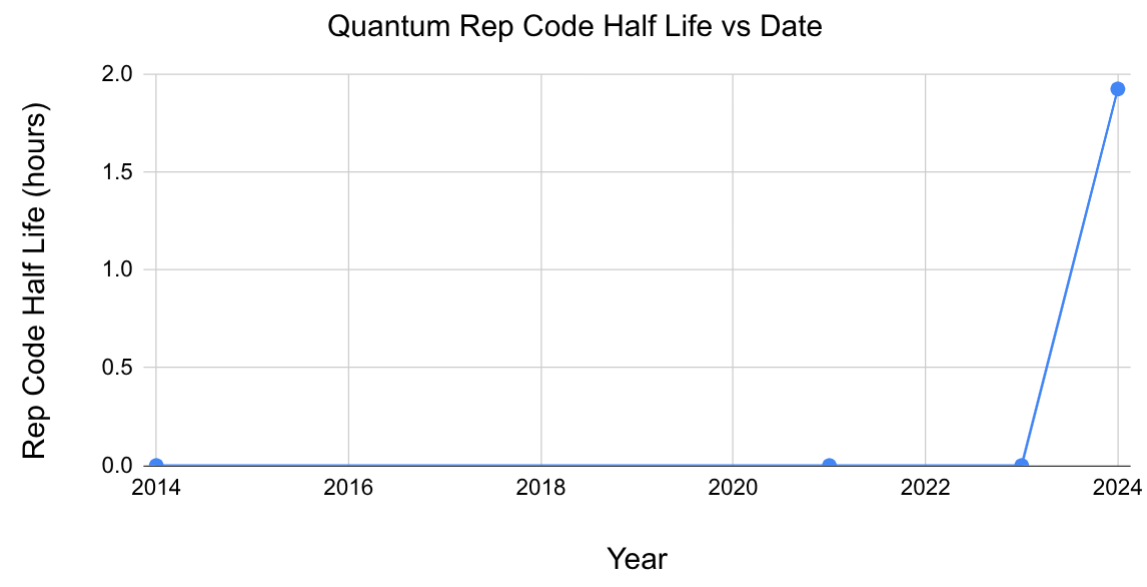
You say you don't see the uranium piling up. Okay. Consider the historically reported lifetimes of classical bits stored using repetition codes on the UCSB->Google machines [1]. In 2014 the stored bit lived less than a second. In 2015 it lived less than a second. 2016? Less than a second. 2017? 2018? 2019? 2020? 2021? 2022? Yeah, less than a second. And this may not surprise you but yes, in 2023, it also lived less than a second. Then, in 2024... kaboom! It's living for hours [4].
You don't see the decreasing gate error rates [2]? The increasing capabilities [3]? The ever larger error correcting code demonstrations [4]? The front-loaded costs and exponential returns inherent to fault tolerance? TFA is absolutely correct: the time to start transitioning to PQC is now.
[0]: https://www.nature.com/articles/414883a
[1]: https://algassert.com/assets/2025-12-24-qec-foom/plot-half-l... (from https://algassert.com/post/2503 )
[2]: https://arxiv.org/abs/2510.17286
One way that stackoverflow does stand out from the other stackexchange sites is that its half life appears far shorter. On a log scale plot it has a steeper descent than the other stackexchange sites. I'm not sure what to make of that. Another interesting thing is that the math stackexchange initially declines more slowly than the others for a year or two and then decays pretty similarly. You can also see examples in some of the other sites of their decay beginning before chatgpt releases (e.g. drupal). You can also see some sites decaying a decade earlier (e.g. expressionengine). I think those outliers are from their subject being too specific and going out of style.
I got the cross-site data from data.stackexchange.com with this vibe-coded query: