

Diederich
Joined 17 years ago
Karma
6,121
Submissions
1,757
Member since
Jun 3
Joined 17 years ago
1. Data. Lots of data.
2. Money. Lots of money.
3. Access to necessary hardware.
4. Business alignment/will to do it.
5. Access to talent, current and future.
This is certainly incomplete/naive. In my mind, though, Google was the clear answer.
On a more personal level, I've been deep into the Google ecosystem since I got [email protected] in 2005. (I actually paid 50 cents on ebay to get a very early invite.) There was no question in my mind that Google's AI work would deeply integrate into their whole ecosystem in very powerful and productive ways. (Yes, I can join you to discuss, at length, the various ways that Google's dominance is problematic/scary.)
Having said all that, I'm quite happy that there is, at the moment, a very rich competitive landscape. Indeed, not too long ago, with Gemini Pro 3.1 languishing, I moved most of my deeper thinking work to ChatGPT, which was, for me at least, clearly outperforming Gemini.
While I certainly didn't anticipate it, Google's strategy of making their fast/relatively inexpensive models surprisingly powerful has been a welcomed surprise.
Starting from the beginning, I have (at least) read through every story and every article, every week, since 1998. Especially in the beginning, there was a lot in each article I didn't understand. I would try to do some digging into those topics.
One way or another, just the weekly exposure to absolutely top notch technical writing was foundational to me.
When newer folk would ask me how to really get good with Linux, I would always point them to LWN.net.
I've been a subscriber since the beginning. That small investment is the least I can do given the incalculable value LWN has brought to me.
I've been thinking about this and your related points, and I've been (with growing concern) instinctively in agreement.
Another analogy has been coming up. I started programming (as a kid) in the late 1970s, first with BASIC (of course) but pretty quickly moved to machine language for obvious performance reasons, and then to C, followed by many other languages. In the late 1980s, at university, I learned proper assembly language, and used it quite a bit.
Back then, I was pretty good with assembly/machine language. Not super star or expert level, but comfortably solid. Since then though I've spent very little time at that low level.
Granted, such early exposure and experience has been a pretty big fairly indirect benefit. But over the years, I've met and worked with many really smart, productive people who have never had any experience at that low level, and that lack was rarely noticeable.
For any given 'layer of abstraction', there is some use in being familiar with the lower layers. I think, in general, the closer the lower layer is, the more useful the knowledge is. For example, how useful is deep knowledge of CPU microcode to a Java programmer? Perhaps some, but not a lot.
In the tech world, GenAI is likely to push most everyone quite a ways up the tower of abstractions. We're in the middle of that right now, and it certainly feels pretty alarming to me.
The biggest uncertainty that comes into my mind is how insanely fast this change is coming upon us. My crawl up the abstraction tower happened over the course of about 12 or so years, from machine language/assembly to C then to Perl then to many other things. In retrospect, that felt pretty fast.
GenAI is seemingly pushing us in that direction many times more quickly.
I get and appreciate that sentiment. Musk currently has a controlling interest in SpaceX. Do you expect that to change after the IPO? Thanks!
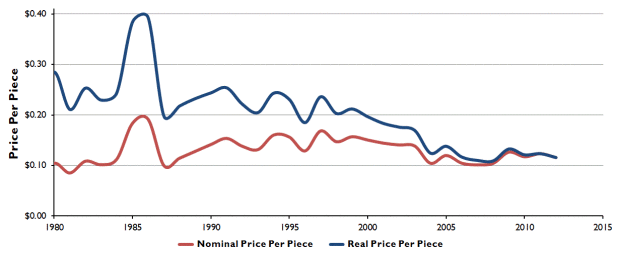
Perhaps sets of a given physical size have more pieces now compared to before? Not sure.
I would really love to hear about this. (:
While I was young in 1975, I did watch ABC's version of the news with my grandparents, and continued up through high school. Then in the late 1980s I got on the Internet and well you know the rest.
"Back Then", a high percentage of everybody I or my grandparents or my friends came into contact with watched one of ABC, NBC, or CBS news most nights. These three networks were a bit different, but they generally they all told the same basic stories as each other.
This was effectively our shared reality. Later in high school as I became more politically focused, I could still talk to anybody, even people who had completely opposite political views as myself. That's because we had a shared view of reality.
Today, tens of millions of people see the exact same footage of an officer involved shooting...many angles, and draw entirely different 'factual' conclusions.
So yes, 50 years ago, we in the United States generally had a share view of reality. That was good in a lot of ways, but it did essentially allow a small set of people in power to decide that convincing a non-trivial percentage of the US population that Exxon was a friendly, family oriented company that was really on your side.
Worth the trade off? Hard to say, but at least 'back then' it was possible, and even common, to have ground political discussions with people 'on the other side', and that's pretty valuable.
I use Gemini to help with shopping decisions pretty frequently. It's been very effective and useful for that.
https://realms.org/pics/cnn.html
Some interesting similarities.
In my 40+ years of driving, I've seen such disassembled cars along the road a hand full of times.
[ my public key: https://keybase.io/diederich; my proof: https://keybase.io/diederich/sigs/QruSKNa2Thg727o9plenYNr2YaaaRAfZWxU_Va_eLuI ]